
Decoupling the Brain-Gut Mismatch: A Professional’s Guide to Cyclical Vomiting Syndrome

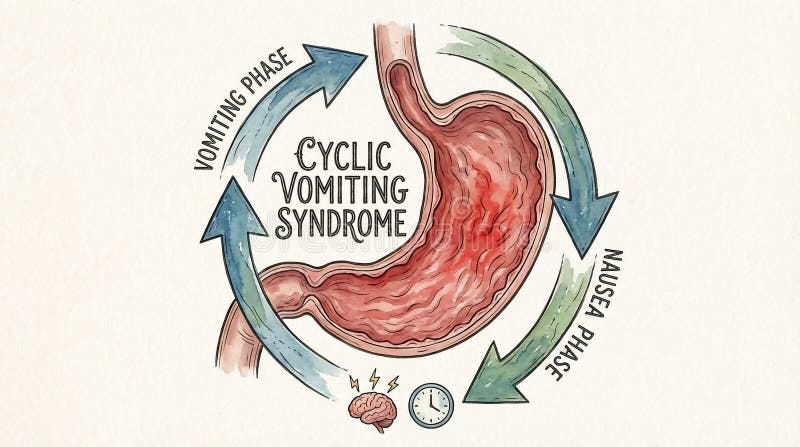
Cyclical Vomiting Syndrome (CVS) is a chronic, episodic functional gastrointestinal disorder characterized by recurrent, stereotypical bouts of severe nausea and vomiting without an identifiable structural cause. The underlying pathophysiology involves a profound sensory mismatch within the autonomic nervous system and the brainstem, closely aligning CVS with the migraine spectrum and central sensitivity syndromes (Raucci et al., 2020). Clinicians must distinguish this condition from mechanical gastrointestinal obstructions and cannabinoid hyperemesis syndrome to implement effective preventative and abortive strategies.
What Drives the Pathophysiology of Cyclical Vomiting Syndrome?
The precise etiology of CVS involves a multisystem disruption in which central nervous system hypersensitivity meets peripheral autonomic dysfunction.
“Research highlights a highly sensitized brainstem—specifically, the solitary tract nucleus and the dorsal motor nucleus of the vagus nerve—that lowers the threshold for emetic triggers.”
When a physiological or psychological stressor breaches this threshold, it activates the corticotropin-releasing factor signaling system. This central surge alters autonomic brain-gut pathways, leading to rapid gastric emptying during well phases and acute gastroparesis during the emetic phase (Shearer et al., 2016).
Furthermore, widespread autonomic dysregulation manifests during acute attacks through symptoms like profound diaphoresis, peripheral vasoconstriction, and orthostatic tachycardia (Kaul & Kaul, 2015). Mitochondrial dysfunction and specific ion channelopathies also impair the enteric nervous system's ability to meet its high-energy demands, predisposing the patient to metabolic crises during periods of fasting or emotional excitement (Boles, 2011).
How Do Maladaptive Sensory Strategies Complicate CVS?
Patients suffering from recurrent autonomic surges frequently develop a distinct sensory mismatch. Because the brainstem misinterprets visceral afferent signals from the gastrointestinal tract, the central nervous system remains in a state of hypervigilance.
“Over time, individuals often demonstrate a strong visual dependency or a strong somatosensory component as they attempt to navigate the severe spatial disorientation, dizziness, and motion sensitivity that accompany the prodromal and emetic phases.”
This maladaptive sensory strategy represents a central failure to integrate vestibular, visual, and somatosensory inputs appropriately. When the brain receives conflicting signals regarding orientation and visceral stability, it defaults to an emetic cascade as a protective, albeit highly disruptive, survival mechanism.

What Do the Latest Clinical Guidelines Recommend for Management?
The North American Society for Pediatric Gastroenterology, Hepatology, and Nutrition (NASPGHAN) published updated clinical guidelines that demonstrate a clear shift toward targeted neuromodulatory and prophylactic interventions (Raucci et al., 2020). Management divides cleanly into abortive therapy for acute events and prophylactic therapy to optimize inter-ictal stability.
Prophylactic Therapy:
First-line prevention for older children and adults relies heavily on tricyclic antidepressants such as amitriptyline, which down-regulate central corticotropin-releasing factor activation and blunt the vagal emetic reflex (Boles, 2011). For younger populations or those sensitive to sedating effects, cyproheptadine offers substantial support.

Recent data highlights the neurokinin-1 receptor antagonist aprepitant as a highly effective option for refractory cases, significantly extending symptom-free periods and reducing hospitalization rates.
“Aprepitant belongs to a class of drugs known as NK1 receptor antagonists. It works by inhibiting the action of substance P, a neuropeptide involved in the vomiting reflex, thereby reducing the likelihood of nausea and vomiting.”
Conversely, current consensus guidelines suggest avoiding anticonvulsants like topiramate or valproate unless the patient remains completely refractory to standard interventions.
Abortive and Supportive Care:
Acute interventions require aggressive fluid resuscitation containing 10% dextrose to halt the ketotic cycle caused by prolonged fasting. Intravenous triptans, ondansetron, and heavy sedation (such as diphenhydramine mixed with chlorpromazine) help terminate the central migraine-equivalent cascade when administered early in the prodromal phase (Kaul & Kaul, 2015).
Why Must Clinicians Screen for Upper Cervical and Vestibular Correlates?
Because the upper cervical spine pathways converge with the trigeminocervical complex and the vagus nerve in the brainstem, mechanical cervical joint dysfunction can directly facilitate a hypersensitive state of the brainstem.
“A thorough clinical examination of the upper cervical spine helps rule in or rule out mechanical nociceptive inputs that may lower the patient’s threshold for an attack.”
By identifying visual and surface dependencies, as well as poor somatosensory integration, during the well phase, clinicians can apply targeted physical therapies to desensitize the central nervous system. Addressing these maladaptive sensory strategies stabilizes the brain-gut microenvironment, coordinates autonomic responses, and significantly optimizes the patient’s long-term functional outcomes.
Clinical Review Disclaimer
The content provided in this article is for educational, informational, and professional review purposes only and does not constitute medical advice, diagnosis, or treatment. This analysis represents a clinical review of existing peer-reviewed literature and functional guidelines regarding Cyclical Vomiting Syndrome (CVS) to facilitate professional education and support clinical learning.
Because CVS involves complex autonomic and multi-system processes, management strategies must always be individualized. Patients experiencing symptoms of CVS must consult a qualified physician or licensed medical professional for proper diagnostic testing, medical management, and treatment options. The author is a physical therapy professional and educator, not a medical doctor; the clinical insights shared here are intended to optimize professional understanding of maladaptive sensory strategies and sensory integration correlates, rather than to serve as direct medical directives.
References
Boles, R. G. (2011). High degree of efficacy in the treatment of cyclic vomiting syndrome with combined co-enzyme Q10, L-carnitine and amitriptyline, a case series. BMC Neurology, 11, 102. https://doi.org/10.1186/1471-2377-11-102 Cited by: 102
Kaul, A., & Kaul, K. K. (2015). Cyclic Vomiting Syndrome: A Functional Disorder. Pediatric Gastroenterology, Hepatology & Nutrition, 18(4), 224. https://doi.org/10.5223/pghn.2015.18.4.224 Cited by: 28
Raucci, U., Borrelli, O., Di Nardo, G., Tambucci, R., Pavone, P., Salvatore, S., Baldassarre, M. E., Cordelli, D. M., Falsaperla, R., Felici, E., Ferilli, M. A. N., Grosso, S., Mallardo, S., Martinelli, D., Quitadamo, P., Pensabene, L., Romano, C., Savasta, S., Spalice, A., Strisciuglio, C., Suppiej, A., Valeriani, M., Zenzeri, L., Verrotti, A., & Staiano, A. (2020). Cyclic Vomiting Syndrome in Children. Frontiers in Neurology, 11, 583425. https://doi.org/10.3389/fneur.2020.583425 Cited by: 84
Shearer, J., Luthra, P., & Ford, A. C. (2016). Cyclic vomiting syndrome: a case series and review of the literature. Frontline Gastroenterology, 9(1), 2–9. https://doi.org/10.1136/flgastro-2016-100705 Cited by: 29