
Exploring the Prevalence of Visual-Vestibular Mismatch in Patients with Idiopathic Dizziness


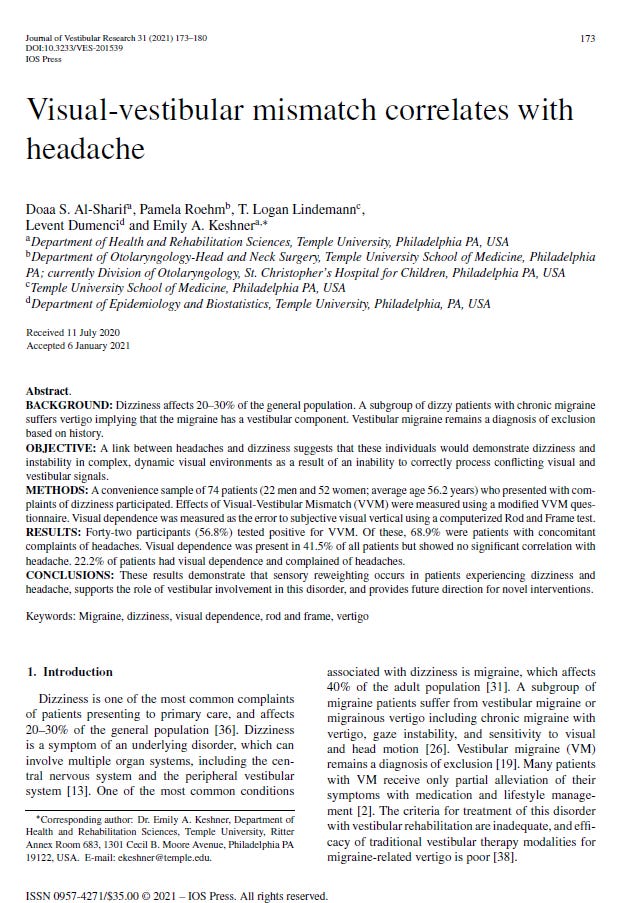
Al-Sharif et al. (2021), in their article published in the Journal of Vestibular Research, investigated the connection between dizziness, headaches, and visual-vestibular mismatch (VVM). In this condition, the brain struggles to process conflicting visual and vestibular signals. The study found a significant association between VVM and headaches, suggesting that VVM may be a contributing factor to dizziness in patients experiencing headaches, especially those with migraines.
Key Findings:
VVM and Headaches: The presence of VVM was significantly associated with patients reporting headaches, implying a potential link between VVM and vestibular migraines.
Visual Dependency (VD): In this study, VD, the reliance on visual cues for balance, was not found to be a significant predictor of headaches.
Gender: The study observed a higher prevalence of VVM in female participants.
Implications:
New Treatment Avenues: The association between headache and VVM hints at potential new rehabilitation strategies, such as visual habituation exercises, for managing vestibular migraines and nonspecific dizziness.
Diagnostic Tool: The VVM questionnaire could be a helpful tool for identifying VVM in patients with dizziness and headaches, leading to more targeted treatment approaches.
Tying in Sensory Strategy Analysis at FYZICAL:
The findings of this study align well with the Sensory Strategy Analysis used at FYZICAL. The Sensory Strategy Analysis evaluates how an individual's brain integrates visual, vestibular (balance), and somatosensory (touch and proprioception) information for balance control.
VVM and Sensory Strategies: The study highlights that VVM indicates a conflict in the brain's sensory integration process, specifically between visual and vestibular inputs. FYZICAL's Sensory Strategy Analysis could help identify mismatches and guide targeted treatment plans.
Visual Habituation and FYZICAL: The study suggests that visual habituation exercises may benefit patients with VVM. FYZICAL's approach to vestibular rehabilitation, which often incorporates customized exercises targeting sensory integration, could include visual habituation techniques to help patients better process conflicting visual and vestibular information.
Overall, the study by Al-Sharif et al. (2021) contributes valuable insights into the relationship between dizziness, headaches, and VVM. By highlighting the potential role of VVM in headache-related dizziness, the research supports the importance of comprehensive assessments like FYZICAL's Sensory Strategy Analysis, which can help identify and address sensory mismatches for improved balance and reduced dizziness.
Further research is needed to explore the efficacy of visual habituation exercises and other rehabilitation approaches targeting VVM in patients with migraines and other headache disorders. This study provides a solid foundation for future investigations in this area.
References and Further Readings
Al-Sharif DS, Roehm P, Lindemann TL, Dumenci L, Keshner EA. Visual-vestibular mismatch correlates with headache. J Vestib Res. 2021;31(3):173-180. doi: 10.3233/VES-201539. PMID: 33522991.