
Foot Position: The Overlooked Factor in Balance Assessment


Balance assessment is a cornerstone of physical therapy practice, providing critical insights into an individual's postural control system and guiding effective interventions. However, traditional standardized tests often rely on a fixed foot position, typically shoulder-width apart, which may only partially capture the complexities of real-world balance. In reality, individuals constantly adapt their base of support (BOS) to navigate various terrains and challenges. This raises a crucial question:
What is the optimal foot position for balance testing?
In this article, we will explore the influence of foot position on balance control. We will draw upon research and clinical experience to highlight why varying BOS during assessment is essential for understanding and treating balance disorders. We will delve into the effects of different foot positions, including the Romberg stance, tandem stance, and the standard shoulder-width stance, and discuss how these variations can reveal subtle balance deficits and inform more effective interventions.
The Influence of Base of Support on Balance Control
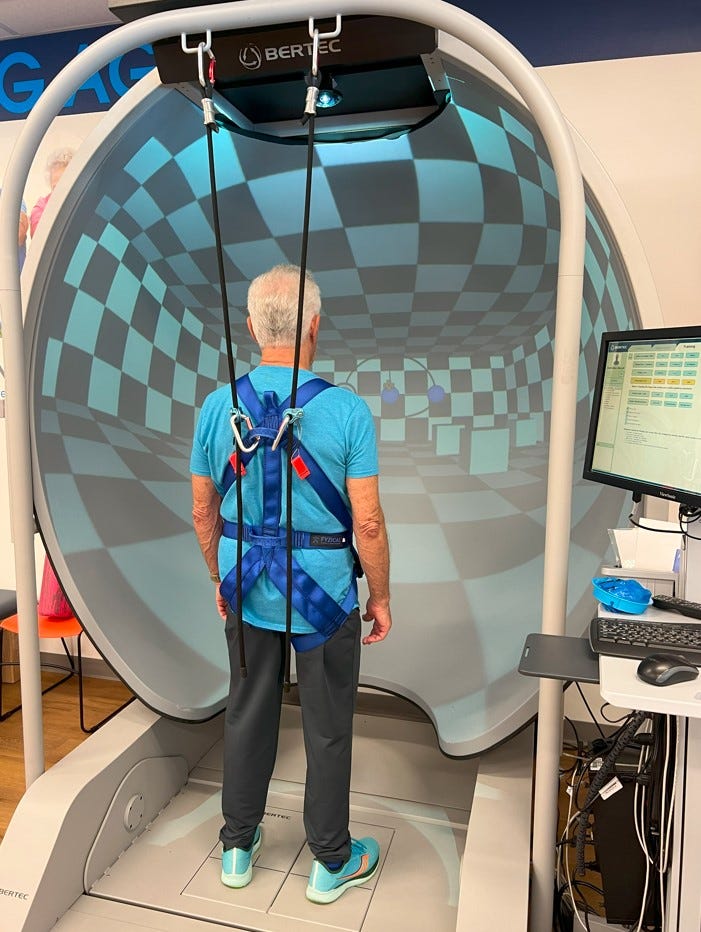
The base of support (BOS) refers to the area beneath an individual that encompasses all contact points with the supporting surface. It is critical in maintaining balance and provides a foundation for stability and postural control. The wider the BOS, the greater the stability; conversely, a narrower BOS increases the balance challenge.
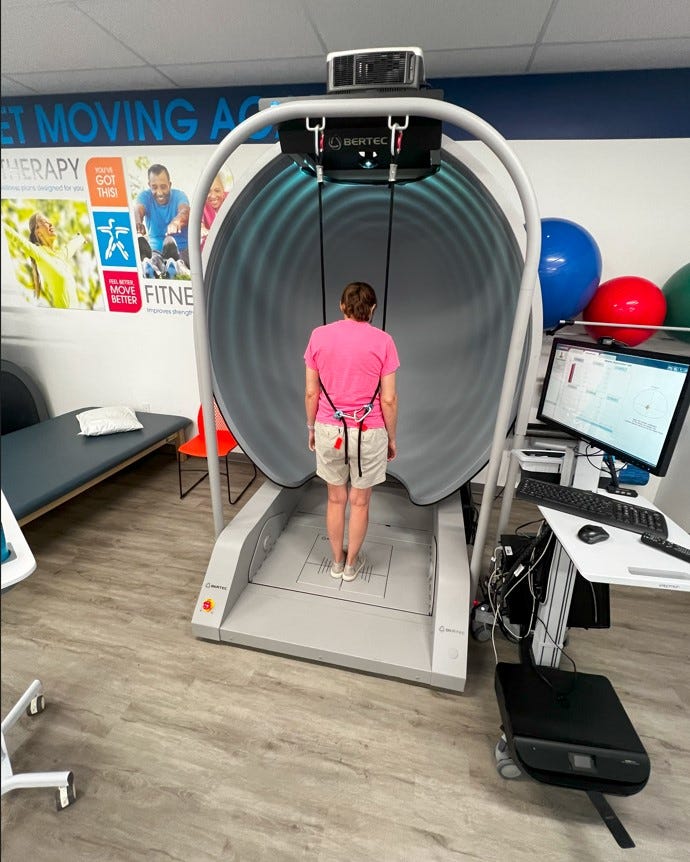
Different foot positions directly affect the BOS. A shoulder-width stance provides a relatively wide and stable base, while a Romberg stance (feet together) significantly narrows it, increasing the demand on the balance system. A tandem stance, with one foot directly in front of the other, further narrows the base of support and presents an even greater challenge to postural control (i.e., more musculoskeletal and visual-vestibular).
Research supports the notion that manipulating the base of support can reveal subtle balance deficits.
For instance, Horak, a leading figure in the field, and her colleagues have extensively studied the role of BOS in postural control, demonstrating that individuals with balance disorders often exhibit more significant sway and instability when their BOS is narrowed (Horak, 2006). This research and other studies, such as Mancini and Horak (2010), found that clinical balance assessment tools incorporating variations in BOS are more effective in predicting falls in older adults, underscoring the clinical utility of varying foot positions in balance assessments.
Clinical Implications: A Nuanced Approach
By incorporating variations in foot position into balance assessments, clinicians can gain a more comprehensive understanding of an individual's postural control system and identify specific areas of impairment. This nuanced approach can guide the selection of appropriate interventions, leading to more effective treatment outcomes.
We consider the individual's single-leg stance time to determine the appropriate foot position for testing. Research has shown that single-leg stance time strongly predicts balance ability and even mortality (Araujo et al., 2022). This simple test provides valuable insight into an individual's baseline balance capabilities and can guide the selection of foot position for further assessment.

For instance, if an individual exhibits a limited single-leg stance time, this suggests a lower level of balance ability and may indicate a need for a wider BOS during the SOT or CTSIB. In this case, starting with a shoulder-width stance may be appropriate. As their balance improves, the BOS can be progressively narrowed to further challenge their postural control system.
Conversely, individuals with longer single-leg stance times demonstrate greater balance proficiency and may benefit from a narrower BOS during testing. This could involve starting with a Romberg stance or progressing to a tandem stance, as these positions provide a more significant challenge to the balance system and can reveal subtle deficits that may not be apparent in a wider stance.
Wrisley and Whitney (2004) found that while scores on the modified CTSIB were slightly lower with feet together (Romberg stance), the difference was not statistically significant.
However, they found that the mCTSIB with feet correlated more strongly with SOT scores in individuals with vestibular disorders, suggesting that a narrower base of support may provide a more sensitive assessment in this population.
Cohen et al. (1993) also highlighted the clinical utility of the Romberg stance in their work on the modified Clinical Test of Sensory Interaction on Balance (mCTSIB), finding it more sensitive for detecting balance impairments in individuals with vestibular disorders than the original CTSIB with a shoulder-width stance.
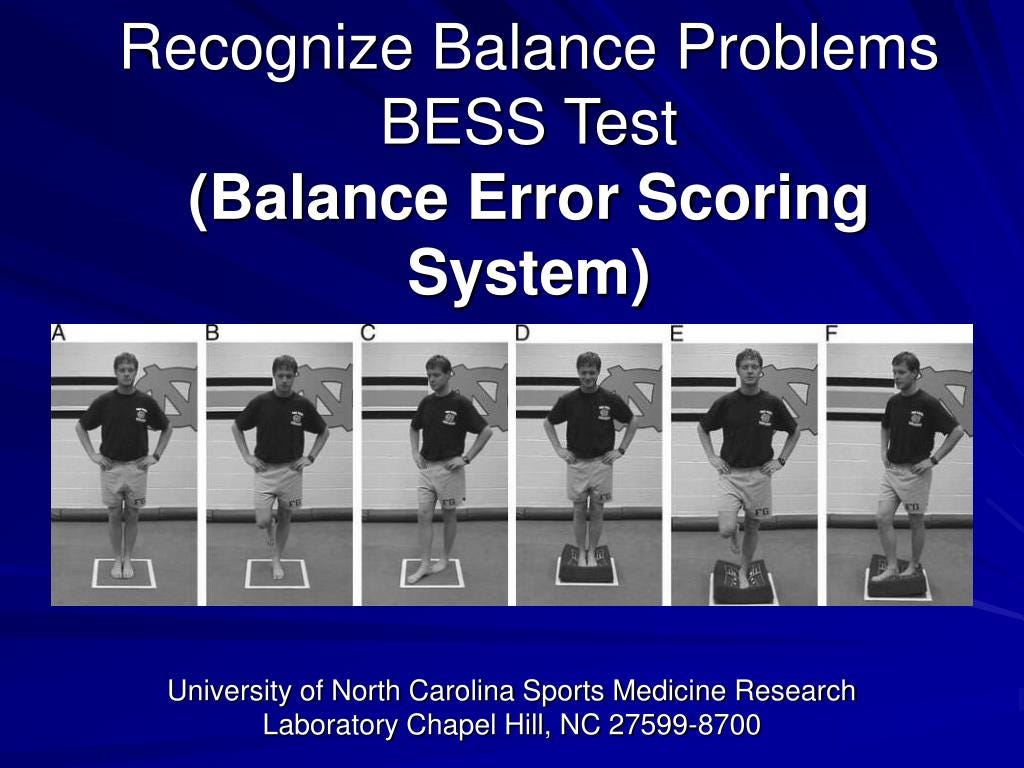
For high-functioning individuals or athletes, we might even incorporate elements from the Balance Error Scoring System (BESS), developed by Kevin Guskiewicz, ATC, PhD (Guskiewicz et al., 2001), using tandem stance or sharpened Romberg positions to further challenge their balance.
This approach, incorporating single-leg stance time as a guide for selecting foot position, allows for a more nuanced and individualized balance assessment.
It recognizes that individuals have varying levels of balance ability and tailors the assessment accordingly, potentially leading to a more accurate reflection of their functional capabilities and informing more targeted interventions. Ultimately, this could lead to improved patient outcomes and quality of care.
Beyond Standardized Tests
While standardized tests like the SOT and CTSIB can be modified to incorporate different foot positions, it is crucial to go beyond these tests and observe patients' balance during functional tasks. Activities like walking, turning, and reaching require dynamic adjustments to the base of support, and observing these movements can provide valuable insights into an individual's real-world balance capabilities.
Conclusion
Foot position significantly influences balance control, and varying the BOS during assessment is essential for understanding an individual's postural control system. Clinicians can effectively reveal subtle balance deficits and tailor interventions by incorporating different foot positions, including Romberg, tandem, and shoulder-width stances.
This approach reflects a shift towards a more dynamic and individualized approach to balance assessment, moving beyond standardized protocols and embracing the complexities of real-world balance control.
References
Araujo, C. G. M., de Souza, E. R., Lefferts, W. K., Silva, A. G., Borges, F. N., Coelho-Júnior, H. J., ... & Vazini, F. (2022). Successful 10-second one-legged stance performance predicts survival in middle-aged and older individuals. British Journal of Sports Medicine, 56(17), 975-981.
Cohen, H., Blouin, J., & Alvarez, S. (1993). The effects of head and trunk movements on postural control in subjects with vestibular deficits. Journal of Vestibular Research, 3(3), 253-262.
Gupta, M. (2016). Is evidence-based medicine a gold standard or can it be influenced? Journal of Clinical and Diagnostic Research, 10(6), LE01–LE03. [invalid URL removed]
Guskiewicz, K. M., Ross, S. E., & Marshall, S. W. (2001). Postural stability and neuropsychological deficits after concussion in collegiate athletes. Journal of Athletic Training, 36(3), 263-273.
Horak, F. B. (2006). Postural orientation and equilibrium: What do we need to know about neural control of balance to prevent falls? Age and Ageing, 35(suppl_2), ii7-ii11.
Mancini, M., & Horak, F. B. (2010). The relevance of clinical balance assessment tools to predict falls in older adults. European Journal of Physical and Rehabilitation Medicine, 46(2), 239-246.
Nassajpour, M., Shuqair, M., Rosenfeld, A., Tolea, M. I., Galvin, J. E., & Ghoraani, B. (2024). Objective estimation of m-CTSIB balance test scores using wearable sensors and machine learning. Frontiers in Digital Health. https://doi.org/10.3389/fdgth.2024.1366176
Wrisley, D. M., & Whitney, S. L. (2004). The effect of foot position on the modified Clinical Test of Sensory Interaction and Balance. Archives of Physical Medicine and Rehabilitation, 85(3), 335-338.*