

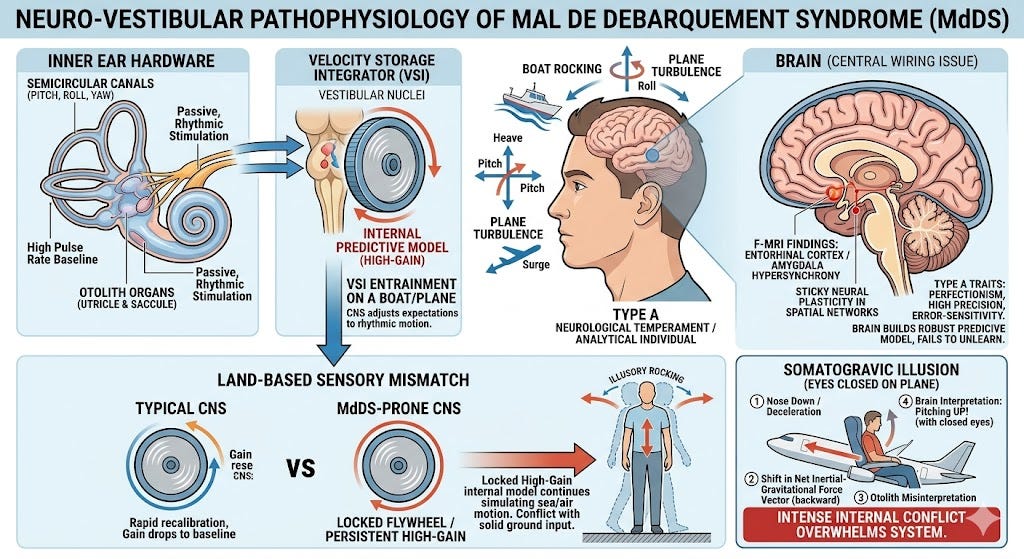
When patients and professionals first look at the infographic detailing the neuro-vestibular pathophysiology of Mal de Debarquement Syndrome (MdDS), the complexity can be overwhelming. But for those of us in vestibular rehabilitation, this image is a physiological roadmap that unlocks why a specific subset of the population—highly functional, analytical “Type A” individuals—gets trapped in a state of persistent rocking.
Let’s break down the complex neural math visualized in this infographic. It explains the journey from a highly tuned, efficient adaptation to a persistent, debilitating neurological error.
1. Inner Ear Hardware: The Motion Sensors
We begin with the Inner Ear Hardware. At all times, your inner ear is sending massive numbers of neural pulses per second to your brain to help you maintain balance. In MdDS, we are not looking at damage to this hardware; we are looking at how it gets calibrated to a specific environment.
Semicircular Canals (Pitch, Roll, Yaw): These detect angular acceleration. They track the tilting, nodding, and rotating motions of a ship or an aircraft.
Otolith Organs (Heave, Sway, Surge): These track linear acceleration—the feeling of bobbing up and down, shunting forward and back, or drifting side to side.
2. Velocity Storage Integrator: The Brain’s Motion Flywheel
This data is funneled into a critical structure in the brainstem called the Velocity Storage Integrator (VSI). As the image illustrates, think of the VSI as a physiological flywheel. Its job is to build an “internal predictive model” of your motion environment.
VSI Entrainment: When you are on a boat, this flywheel builds a high-gain model to match the rhythmic oscillations of the water. The brain shifts its gain up to actively accommodate and predict the movement. The nervous system isn’t just following the motion; it’s anticipating it.
3. Brain (Central Wiring Issue): The Analytical Vulnerability
This is where the “triple-hit” hypothesis, visualized in the chart, explains why some people get stuck. The infographic highlights that this is a Central Wiring Issue, particularly common in individuals with a specific neural architecture.
F-MRI Findings & Neural Plasticity: Studies show hypersynchrony between the entorhinal cortex (involved in spatial navigation) and the amygdala.
Type A Temperament: These brains are brilliant at optimization and error-sensitive. This high-precision architecture builds an incredibly robust predictive model. Their brains don’t just “go with the flow”; they build a flawless mathematical map of the sea.
4. Land-Based Sensory Mismatch: The Failure to Reset
This section visualizes the failure that leads to MdDS. Your brain learns the motion of the sea so perfectly that it turns an efficient short-term adaptation into a persistent error.
Typical CNS: When most people return to land, the velocity storage integrator quickly recalibrates. The flywheel discharges its stored energy, and the gain drops back to its dry-land settings. The predictive model resets.
MdDS-Prone CNS: In the “sticky” hardware of the analytical mind, this does not happen. The brain learns the motion too well and cannot let it go. The Velocity Storage Integrator remains locked in its high-gain sea state.
5. Somatogravic Illusion: The Closed-Eye Flip
The final section of the infographic illustrates the intense internal conflict that overwhelms the system. It uses the example of an Eyes-Closed Somatogravic Illusion on a plane.
Without a strong visual component, the brain must interpret raw input from the otoliths and semicircular canals. If the plane's nose drops and decelerates, the otolith organs register a backward shift in the gravity vector. Without eyes open to correct the mistake, the high-precision brain—constantly trying to calculate and offset motion—misinterprets this inertial force, flips the math, and creates the powerful illusion that you are pitching UP.
This intense conflict is precisely what overwhelms the analytical nervous system, bombing the velocity storage integrator with contradicting, high-frequency signals and forcing it into a persistent, defensive compensation loop.
Thanks Brian for your awesome work!