
POTS and Cerebral Autoregulation: The Physiological Survival Triage
Understanding the Physiological Bottleneck: Why Your Body Prioritizes Blood Flow Over Lymphatic Drainage in POTS


In human biology, the brain is the top priority. It needs a constant supply of oxygen and glucose to maintain consciousness and cellular health. When ‘POTS’ (Postural Orthostatic Tachycardia Syndrome) threatens this supply, the body enters physiological triage.
Clinicians note that the body appears to temporarily prioritize blood and oxygen delivery to the brain to meet immediate demands, thereby temporarily deprioritizing the lymphatic system. This is a direct reallocation of resources during times of physiological stress.
The Mechanism of Cerebral Hypoperfusion
When an individual with ‘POTS’ stands, gravity causes blood to pool in the lower extremities, leading to ‘cerebral hypoperfusion’—a significant drop in blood flow to the brain. To prevent syncope (fainting), the autonomic nervous system enters a state of high alert. It increases norepinephrine levels and raises heart rate to force blood upward against gravitational pressure.
During this process, the body shifts away from routine maintenance functions it considers less critical. The lymphatic system—operating under low pressure without a central pump—slows down. While the cardiovascular system sustains brain oxygenation, the clearance of metabolic waste temporarily decreases.
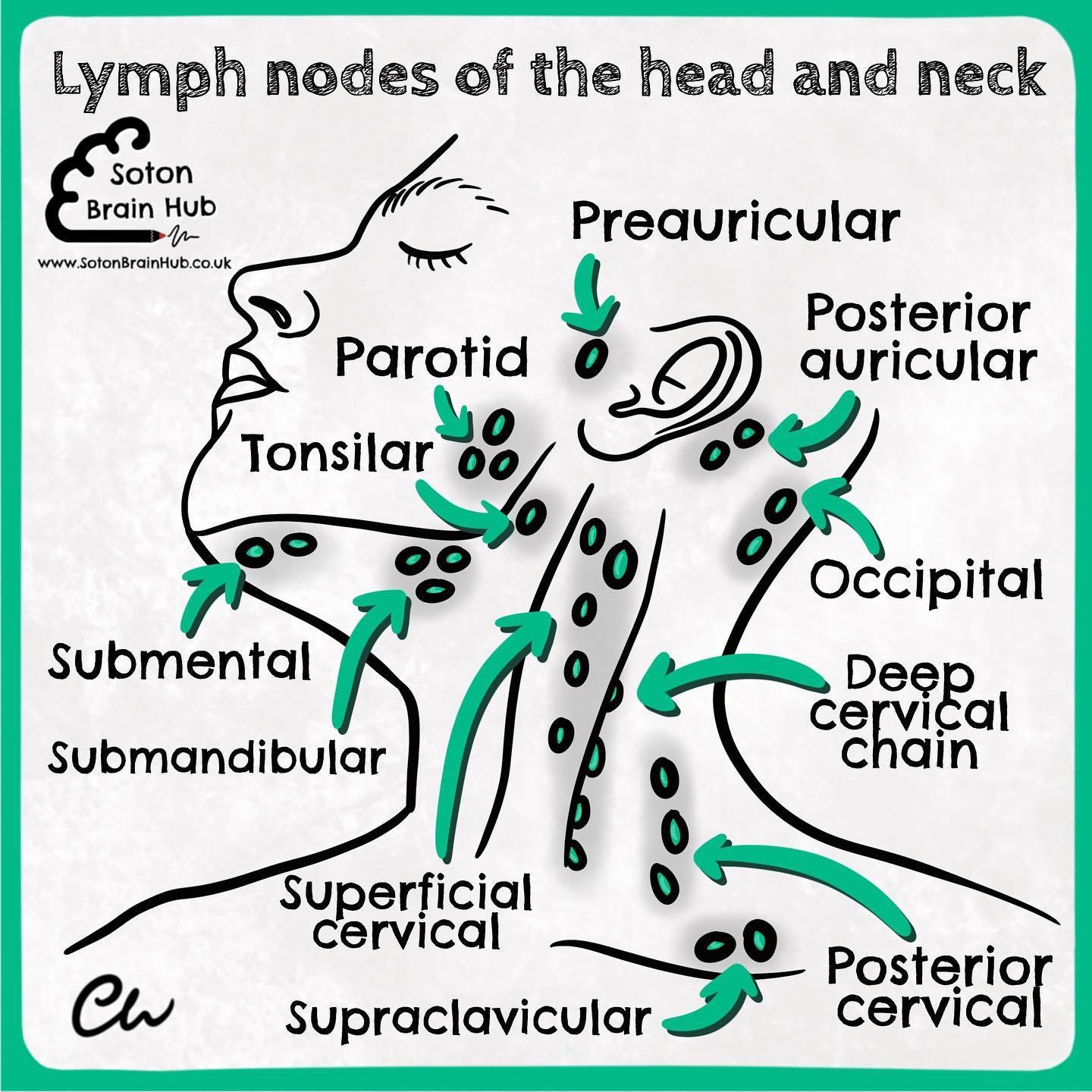
The Bottleneck: Deep Cervical Lymph Nodes
The critical intersection of this struggle resides in the neck. The ‘deep cervical lymph nodes’ function as the primary drainage basins for the brain’s unique waste-clearance pathway, the glymphatic system.
Current research suggests these nodes directly influence the brain’s ability to regulate its own blood flow through several mechanisms:
Fluid Pressure Dynamics: If these deep cervical nodes become congested due to the body’s physiological ‘pause,’ fluid backs up into the head. This can increase intracranial pressure (the pressure within the skull), which may squeeze tiny blood vessels, making it harder for fresh, oxygen-rich blood to reach the brain.
Chemical Signaling Interference: The lymph carries metabolic byproducts away from neural tissue. When drainage is impeded, these metabolic wastes accumulate. This buildup can interfere with the chemical signals that govern vasodilation and vasoconstriction, crippling the brain’s ability to autoregulate.
Structural Compression: During a POTS flare (worsening of symptoms), neck muscles often become tense to protect the area. This muscular tightness can compress the deep cervical lymph nodes, obstructing drainage at a time when blood flow to the brain is already compromised.
Manual Interventions to Restore Drainage
To resolve this bottleneck and support cerebral autoregulation, one must utilize manual techniques that encourage the ‘deep cervical lymph nodes’ to resume activity. These techniques require a light, superficial touch—specifically, enough pressure to stretch the skin without compressing the underlying vessels.
1. The Supraclavicular Pump
The final terminus for the entire lymphatic system is the thoracic duct, located just above the collarbones. This area must be cleared first to allow upward drainage.
Technique: Place fingertips in the supraclavicular fossae (the hollows above the collarbones). Apply soft, rhythmic pulses toward the neck.
Instructional Resource: How to Clear the Thoracic Duct
2. The Deep Cervical Flush
The deep cervical nodes reside along the path of the sternocleidomastoid (SCM) muscle.
Technique: Rotate the head slightly. Starting from the mastoid process (behind the ear), use a flat hand to perform gentle, downward strokes toward the collarbone.
Instructional Resource: Cervical Lymphatic Drainage Technique
3. Sub-Occipital Release
The craniocervical junction is a central transit point for the vertebral arteries and for the glymphatic system.
Technique: Place fingertips at the base of the skull. Apply a steady, gentle cephalad (upward) traction while maintaining deep, diaphragmatic breathing.
Instructional Resource: Sub-Occipital Release for Brain Blood Flow
Clinical Protocol: Frequency and Dosage
Consistency drives lymphatic retraining. Perform the sequence three times daily: morning, midday, and night.
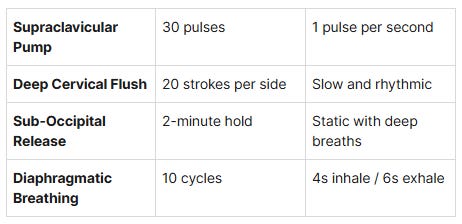
Quantitative and Qualitative Metrics
Monitor the following markers to verify that the system is successfully ‘unpausing’:
Direct Drainage Markers: Observe for an immediate need to swallow or a noticeable clearing of the nasal passages. This indicates the bottleneck is opening.
Cognitive Load Assessment: Evaluate the severity of ‘brain fog’ on a scale of 1–10. A reduction in perceived head pressure within 15 minutes suggests improved drainage.
Autonomic Stability: Monitor heart rate trends over time. As drainage improves and intracranial pressure stabilizes, many find that the aggressive heart rate spikes associated with ‘POTS’ begin to moderate.
By using these manual strategies, you help the autonomic nervous system move from a survival-focused state back toward homeostatic balance.
References
Jin H, Yoon JH, Hong SP, Hwang YS, Yang MJ, Choi J, Kang HJ, Baek SE, Jin C, Jung J, Kim HJ, Seo J, Won J, Lim KS, Jeon CY, Lee Y, Davis MJ, Park HS, McDonald DM, Koh GY. Increased CSF drainage by non-invasive manipulation of cervical lymphatics. Nature. 2025 Jul;643(8072):755-767. doi: 10.1038/s41586-025-09052-5. Epub 2025 Jun 4. PMID: 40468071; PMCID: PMC12267054.
Very interesting- I see a fair amount of youth patients with the dx of POTS… only saw this, post COVID