
The 1982 Breakthrough That Still Informs Balance Science and Practice


Decades ago, a pivotal study revolutionized our understanding of how the brain manages balance, offering insights that remain critically important for vestibular professionals today. In 1982, researchers Lewis Nashner, F. Owen Black, and Conrad Wall, III, published their groundbreaking work, ‘Adaptation to Altered Support and Visual Conditions During Stance: Patients With Vestibular Deficits.’ This wasn't just an academic exercise; it laid a critical foundation for the very principles we use every day within the FYZICAL Balance Paradigm.
At its core, the Nashner study revealed a profound truth: the vestibular system functions as our internal GPS for orientation. It provides a reliable, inertial-gravitational reference point. Our brains then use this constant reference to filter and appropriately weight information coming from our feet (somatosensory inputs) and our eyes (visual inputs).

The "Aha!" Moment: When the Internal Reference Fails
Nashner and his team didn't just observe; they designed a sophisticated platform that could move both the support surface and the visual environment. This allowed them to meticulously investigate how individuals with vestibular deficits responded when their somatosensory and visual cues became unreliable or misleading.
Here's what they discovered:
Fixed Surface, Decent Performance: On a stable surface, even patients with vestibular problems maintained balance relatively well. They effectively utilized their somatosensory input, demonstrating its powerful stabilizing influence when it was reliable.
The Critical Breakdown: Sensory Conflict: The actual challenge emerged when the support surface or visual surround began to move, providing inaccurate or conflicting information. Patients with vestibular deficits, even those with mild impairments, suddenly became profoundly unstable. Their compromised vestibular system could not provide an adequate, stable internal reference. They could not suppress the misleading somatosensory and visual inputs. This over-reliance on unreliable cues frequently led to instability and loss of balance.
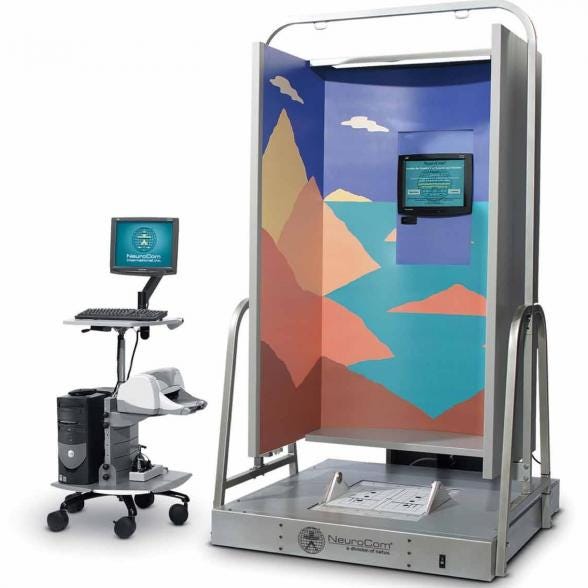
This concept is crucial. It underscores that vestibular dysfunction isn't solely about the loss of direct vestibular input to posture; it's profoundly about the inability to quickly and accurately re-weight sensory information when the external environment introduces sensory conflicts. This breakdown in adaptation to altered sensory conditions became a central observation.
Correlating Past Research with Present-Day Application: Maladaptive Sensory Strategies
This 1982 research directly underpins the core principles of the FYZICAL Balance Paradigm, particularly our sophisticated understanding of Sensory Strategies and their role in balance disorders. The seminal findings on adaptation and sensory re-weighting from Nashner's study find direct application in our clinical approach:
When evaluating a patient presenting with Vestibular Hypofunction (Vh), we frequently observe them developing maladaptive dependencies on other senses.
Nashner's work elucidates the mechanism behind these presentations:
VH-SOM (Vestibular Hypofunction with Somatosensory Dependency): This patient struggles when the surface is uneven or compliant because they over-rely on somatosensory input, much like the study's patients who were unable to suppress inaccurate surface cues. This is a clinical presentation often correlated with an SVM.
VH-VIS (Vestibular Hypofunction with Visual Dependency): Similarly, this patient becomes unsteady in visually rich environments or low-light conditions. They over-rely on vision, experiencing a clinical presentation often correlated with a VVM.
SVM (Somatosensory-Vestibular Mismatch): In this strategy, the patient overrelies on surface cues more than on visual cues due to a vestibular deficit. While less profound than other mismatches, it indicates an inappropriate weighting where somatosensory input is prioritized over vestibular information.
VVM (Visual-Vestibular Mismatch - Mallinson, 2012): In this condition, patients overrely on visual cues rather than somatosensory cues due to vestibular dysfunction. This less profound dependency still leads to dizziness symptoms and signs when visual information becomes unreliable or conflicting.
These mismatches, while less severe than those indicating a profound vestibular dysfunction, are still maladaptive. They represent the brain's attempt to control balance by inappropriately weighting available sensory information when the vestibular system is not providing a clear signal. Building on these, the study's findings also explain more pronounced dependencies:
SVVM (Somatosensory>Visual-Vestibular Mismatch): This indicates a patient's over-reliance on surface cues greater than visual cues due to a profound vestibular dysfunction.
VSVM (Visual > Somatosensory-Vestibular Mismatch): Here, the patient exhibits an over-reliance on visual cues that exceeds surface cues due to profound vestibular dysfunction.
The ultimate goal of our interventions is to guide patients away from these maladaptive sensory strategies—whether SVM, VVM, SVVM, or VSVM—and help them return to a normal, healthy sensory strategy. The study's experimental design, manipulating support surface and visual information, mirrors the theoretical framework of our FYZICAL-CTSIB (F-Clinical Test of Sensory Interaction in Balance). By systematically altering sensory conditions, we clinically assess precisely where a patient's sensory organization and adaptive capacity break down.
The brilliance of Nashner, Black, and Wall's work, dating back over 40 years, remains foundational. It provides the critical scientific backbone for why we emphasize adaptation and the meticulous analysis of sensory strategies in balance rehabilitation within the FYZICAL Balance Paradigm. This historical research is not merely interesting; it is fundamentally essential for guiding our modern clinical evaluations and interventions, ensuring we address the root causes of instability stemming from impaired sensory organization.
Fantastic detailed rationale to the FYZICAL balance paradigm based on the sensory mismatch