
The Dysplastic Downbeat: When a Peripheral Deficit Drives a Pseudo-Central Sign


As vestibular professionals, we seldom encounter a case that simultaneously validates the rules of VOR physiology and highlights their exceptions. I reviewed an analysis case—the convergence of semicircular canal dysplasia and a persistent Downbeat Nystagmus (DBN). This analysis focuses on reconciling the peripheral cause with the central sign via the concept of tonic disinhibition.
The Confounding Clinical Picture
The case I reviewed was that of a patient referred for balance testing, presenting with a compelling, lifelong history. Since childhood, the patient has been experiencing episodes of disequilibrium, a feeling of ‘wooshing over the brain,’ and spinning when lying flat on the back. These symptoms recurred with positional change and caused significant nausea. The familial component—the patient’s sister shares a similar history—immediately suggested a congenital etiology.
Standard testing yielded normal results for the lateral canals (calorics) and oculomotor function (smooth pursuits, OKS). Crucially, the Dix-Hallpike maneuver was negative, eliminating typical Benign Paroxysmal Positional Vertigo (BPPV).
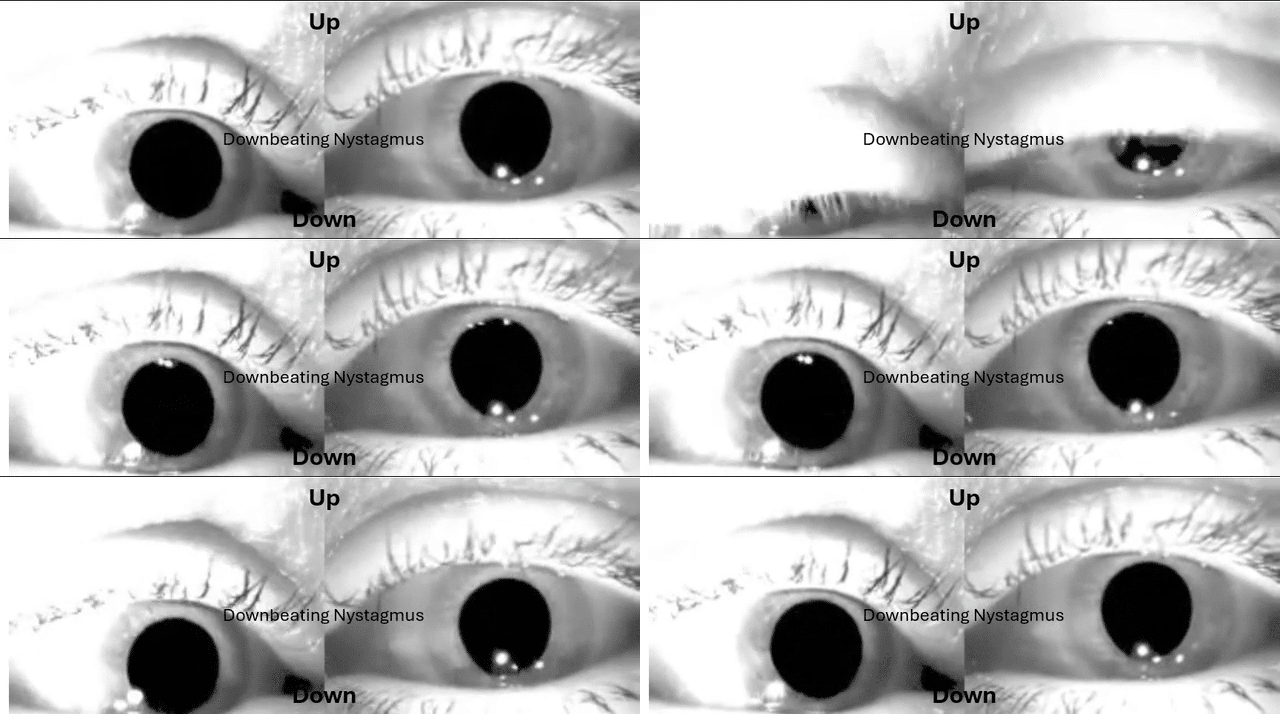
The significant finding in the objective exam was a persistent, pure Downbeat Nystagmus (DBN) in primary gaze.
Ruling Out the Common Causes
In a typical clinical scenario, a persistent DBN mandates a central workup, as it usually results from cerebellar or brainstem pathology. The MRI of the brain confirmed that the brainstem, cerebellum, and cerebellopontine angles were structurally normal, ruling out common central DBN etiologies (e.g., flocculus lesions, atrophy). This thorough process ensures that the pathology must reside elsewhere.
The Structural Truth: Vertical Canal Dysplasia
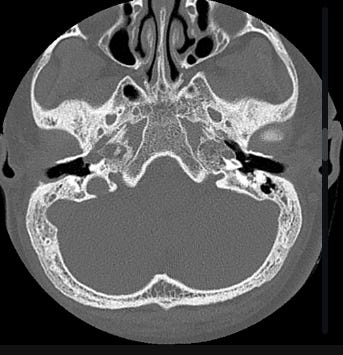
The same MRI revealed the source of the problem. The MRI showed a rare, bilateral congenital malformation of the vertical semicircular canals:
‘The posterior semicircular canal appears to be discontinuous. The superior canal appears small along the posterior limb bilaterally.’
This finding identifies a profound, chronic bilateral vertical canal vestibulopathy. A discontinuous or hypoplastic canal functions hypofunctionally or non-functionally. The patient, therefore, lacks regular afferent input from the posterior and superior canals bilaterally.
The Pathophysiology: Disinhibition and the DBN Vector
The key to understanding Downbeat Nystagmus lies in the concept of vertical VOR tonic imbalance, which results from a peripheral structural defect. We must analyze the VOR vectors:
DBN Vector: Downbeat Nystagmus is named for its fast phase beating down. Its slow phase, the pathological drift, is directed upward.
Canal Contribution to Upward Slow Phase: Excitation of the Superior Semicircular Canals (SSCCs) physiologically drives a corrective eye movement with a slow phase directed upward.
The Chronic Imbalance: The structural defect creates a chronic, lifelong absence of effective tone from the Posterior Semicircular Canals (PSCCs). These canals typically provide an opposing or inhibitory tone to the vertical VOR pathways.
Disinhibition: With the opposing tone from the bilateral PSCCs chronically diminished, the vertical system is thrown into a state of uncompensated tonic bias. The intact (or relatively less-impaired) SSCCs or their central connections become the unopposed, dominant signal. This vertical VOR imbalance is a state of disinhibition, which mimics a central lesion.
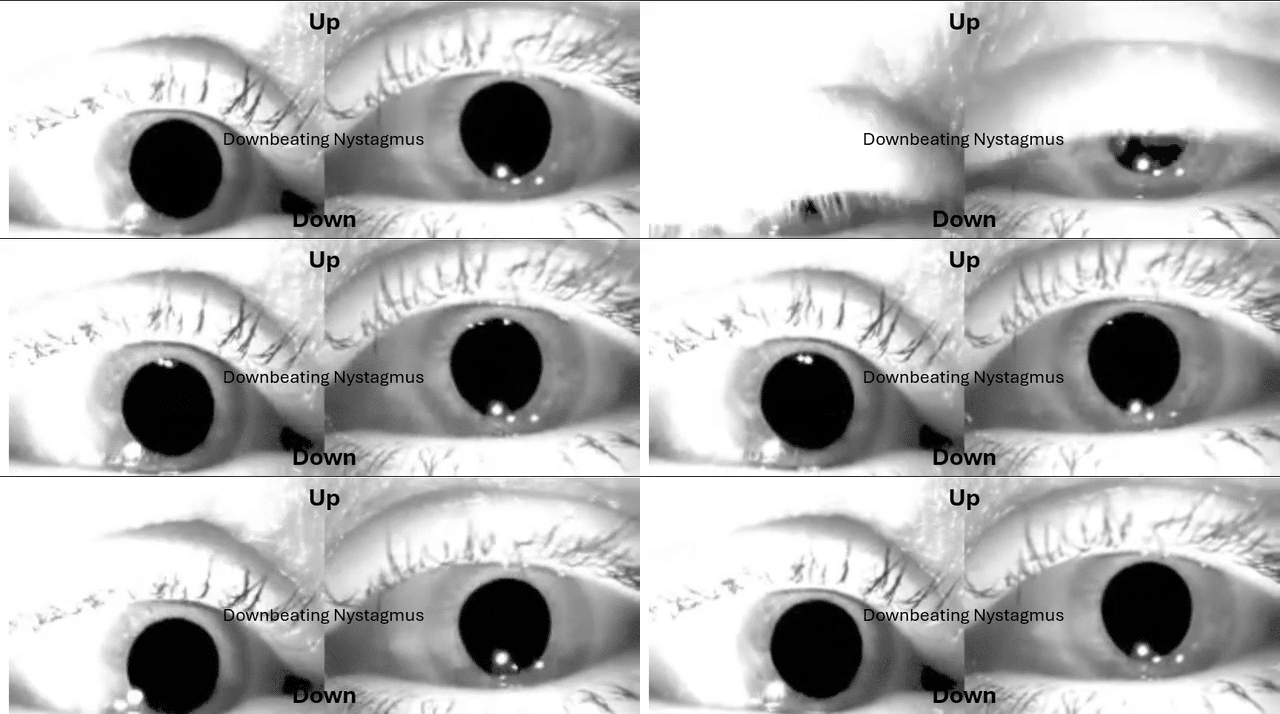
The Resulting Nystagmus: This relative hypertonia of the SSCC pathways causes a continuous slow-phase upward drift of the eyes. The CNS generates the corrective saccade beating downward, producing the persistent Downbeat Nystagmus.
The fact that the DBN is pure vertical, lacking a significant torsional component, perfectly supports the bilateral nature of the lesion. If only one side were affected, a torsional component would be evident. Here, the torsional vectors from the bilateral vertical canals cancel out, leaving only the net pure vertical drift. This result confirms that the peripheral dysplasia is the driver of the DBN.
Clinical Management: A Blended Adaptation Strategy
Given that this pathology establishes a fixed, chronic tone imbalance (a predictable slow-phase upward drift), the most precise therapeutic approach is a blended strategy prioritizing adaptation.
Gaze Stabilization Adaptation: Gaze Stabilization Training (e.g., VOR ×1 and VOR ×2 in the vertical plane) initiates central cerebellar-vestibular recalibration, a form of adaptation training. This VOR gain modification aims to drive the central cerebellar-vestibular connections to recalibrate the faulty vertical VOR pathways, attempting to reduce the magnitude of the DBN and associated oscillopsia.
Habituation for Positional Intolerance: We use habituation exercises (repeated, controlled positional maneuvers like supine-to-sit and sit-to-supine) to directly target the patient’s lifelong, positional dizziness and nausea. This approach allows the central nervous system to become accustomed to the aberrant sensory input generated by the dysplastic canals upon movement.
Sensory Re-Weighting and Balance Adaptation: We implement comprehensive Static and Dynamic Balance Challenging exercises, strictly adhering to the FYZICAL Balance Paradigm. This sensory re-weighting physical therapy is a critical component of adaptation training. This approach helps the patient overcome maladaptive sensory strategies—such as ‘an SVM or a VVM, etc.’—by optimizing the CNS’s reliance on their somatosensory and visual systems to compensate for the lifelong vertical vestibular loss.
This complex case serves as a critical reminder that a deep understanding of neuro-otologic function must allow for the possibility of a primary peripheral lesion masquerading as a central sign. It also underscores the importance of an equally sophisticated, targeted rehabilitation plan, which offers hope for the patient’s recovery.
Brian K. Werner, PT, MPT, is a physical therapist who has been specializing in vestibular and balance disorders for over a quarter of a century. He is the founder of the FYZICAL Balance Paradigm and one of the co-founders of FYZICAL, LLC, Balance Center Division with Dr. Daniel Deems, MD, PhD, where he serves as the National Director of Vestibular Education & Training.