
The Unseen Progress: When the Patient's Perception Doesn't Align with Objective Improvement


Introduction:
Imagine an 80-year-old woman, let's call her Susan, who loves staying active. She enjoys playing pickleball with her friends, taking walks in her beautiful island community, and tending to her garden. But lately, something's been off. Susan's been feeling increasingly unsteady on her feet, plagued by a nagging fear of falling. She's even experienced a few episodes of vertigo, that unsettling spinning sensation that makes the world feel like a tilt-a-whirl.
As a skilled vestibular therapist, you step in to evaluate Susan's condition. You uncover a history of recurrent dizziness and imbalance, with a recent decline in her function. Your examination reveals a positive head impulse test, suggesting a vestibular deficit, and you suspect an underlying condition called utricular macular degeneration, which affects the balance organs in the inner ear.
To better understand Susan's balance challenges, you conduct an instrumented CTSIB called a Sensory Organization Test (SOT). The results reveal a significant over-reliance on surface cues (somatosensory dependence) and vision, with a greater reliance on surface cues. This indicates a sensory mismatch, precisely an SVVM strategy (Somatosensory > Vision-Vestibular Mismatch), likely contributing to her dizziness and unsteadiness.
You begin a comprehensive treatment program, incorporating vestibular rehabilitation exercises, balance training, and therapeutic exercises to strengthen her legs and core. You also provide education about her condition, fall prevention strategies, and the importance of managing her alcohol consumption, which may be exacerbating her symptoms.
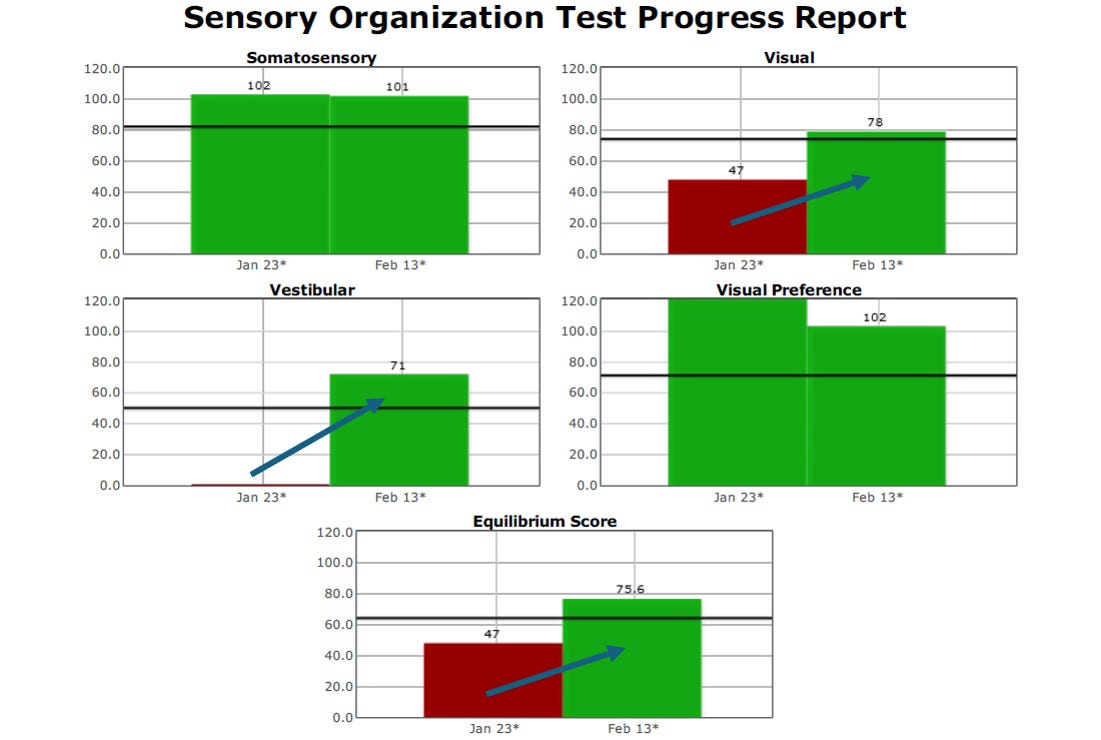
After a few weeks of consistent therapy, you retest Susan using the CTSIB. The results are encouraging! Her scores have improved significantly, and her sensory strategy has shifted from SVVM to SVM (Somatosensory-Vestibular Mismatch). This indicates a reduction in her over-reliance on vision and a more balanced integration of her somatosensory and vestibular systems. Objectively, she's making excellent progress. But there's a catch. Susan doesn't feel any better. She still reports feeling unsteady and expresses frustration that she's not experiencing the improvement the tests indicate.
This, my fellow vestibular therapists, is the crux of the matter. We often encounter this disconnect between our patients' objective progress and subjective perception. It's a phenomenon that can be perplexing and requires a nuanced understanding of the complexities of balance disorders and the process of recovery.
Understanding the Disconnect:
Several factors may contribute to this discrepancy between objective improvement and subjective perception:
Neuroplasticity and Adaptation: Vestibular rehabilitation promotes neuroplasticity, the brain's remarkable ability to reorganize and adapt to injury or change. However, this process takes time. While objective improvements, such as increased scores on the CTSIB, may be evident early on, it takes time for the brain to fully integrate these changes into everyday function and for the patient to perceive the improvements consciously. This is a gradual process, much like learning a new language – you can memorize vocabulary and grammar rules (objective improvement). Still, it takes consistent practice and immersion to become fluent and comfortable using the language in conversation (subjective improvement).
Sensory Reweighting: Patients with vestibular disorders often develop maladaptive sensory strategies, relying too heavily on certain senses (like vision or somatosensation) while underusing others (like the vestibular system). This can lead to a sensory mismatch, where the brain receives conflicting information from different sensory systems, contributing to dizziness and unsteadiness. Vestibular rehabilitation aims to reweight these sensory inputs, promoting a more balanced and integrated approach to balance control. However, this reweighting process can be challenging. The brain has become accustomed to relying on specific sensory cues, and it takes time and practice to establish a new, more adaptive sensory strategy. Imagine a musician who has always played the piano with one hand. Learning to play with both hands requires a rewiring of motor patterns and a recalibration of sensory feedback, which takes time and dedicated practice.
Psychological Factors: Anxiety, fear of falling, and other psychological factors can significantly influence a patient's perception of their balance. These emotional factors may persist even with objective improvement, hindering their subjective sense of stability and confidence. Think of a tightrope walker who has recovered from an ankle injury. While their ankle may be physically healed (objective improvement), they may still experience fear and anxiety when stepping back onto the tightrope (subjective perception), impacting their performance.
Physiological Adaptation: The vestibular system, responsible for balance and spatial orientation, is intricately connected to other physiological systems, such as the autonomic nervous system (which regulates heart rate, blood pressure, and other automatic functions). When the vestibular system is impaired, it can trigger changes in these different systems, leading to symptoms like nausea, sweating, and increased anxiety. Even when objective balance improves, it may take time for these physiological responses to normalize, contributing to the patient's continued perception of dizziness or discomfort.
Cognitive and Perceptual Factors: Our perception of balance is not solely determined by sensory input. It also involves cognitive processes, such as attention, memory, and expectation. In patients with vestibular disorders, these mental processes may be affected, leading to altered body perception and an increased awareness of balance challenges. Even with objective improvement, the patient may continue to focus on their perceived instability, hindering their subjective sense of progress.
Bridging the Gap: Strategies for Vestibular Therapists
Understanding the factors that contribute to this disconnect between objective and subjective improvement allows us to develop strategies to bridge the gap and optimize patient outcomes:
Education is Key: Clearly explain the concept of sensory mismatch, neuroplasticity, and the gradual nature of vestibular adaptation to the patient. Use analogies and metaphors to illustrate these concepts in a relatable way. Help them understand that objective improvement often precedes subjective improvement and that their brain needs time to adapt.
Acknowledge and Validate: Acknowledging and validating the patient's frustration and concerns is crucial. Emphasize that their feelings are valid and that you understand their challenges. This empathetic approach helps build trust and rapport, creating a safe space for them to share their experiences.
Focus on Functional Goals: Connecting the objective improvements to the patient's functional goals is essential. Help them see how their gains on tests translate into improving their ability to perform daily activities and participate in meaningful activities. This goal-oriented approach can help motivate the patient. For example, if a patient's CTSIB scores improve, explain how this relates to their goal of walking confidently in the grocery store or returning to their favorite sport.
Address Psychological Factors: Incorporate strategies to address anxiety and fear of falling, which can hinder subjective improvement even when objective progress is evident. This may include relaxation techniques, mindfulness exercises, and graded exposure to challenging environments. By addressing the emotional component of balance disorders, we can help patients regain confidence and reduce their fear of movement.
Celebrate Small Victories: Celebrate every small victory along the way. This can help boost the patient's confidence and motivation, even if they haven't reached their ultimate goals yet. Recognizing and acknowledging their progress, no matter how small, reinforces their efforts and encourages them to continue the rehabilitation process.
Foster Self-Efficacy: Encourage patients to actively participate in their recovery by setting realistic goals, monitoring their progress, and engaging in self-management strategies. This fosters a sense of self-efficacy and empowers them to take control of their condition.
Promote a Growth Mindset: Cultivate a growth mindset by emphasizing that balance abilities can be improved through practice and persistence. This helps patients view challenges as opportunities for learning and growth rather than setbacks.
Communicate Effectively: Maintain open and honest communication with patients throughout their rehabilitation journey. Provide regular updates on their progress, address their concerns, and adjust the treatment plan as needed. This collaborative approach fosters trust and encourages patients to participate actively in their recovery.
Conclusion:
The discrepancy between objective improvement and subjective perception is a common challenge in vestibular rehabilitation. By understanding the factors contributing to this disconnect and implementing strategies to bridge the gap, we can empower our patients to embrace their progress, even if they don't 'feel it' yet. This approach fosters a stronger therapeutic alliance and promotes better long-term outcomes for our patients.
Remember, our role as vestibular therapists extends beyond simply addressing impairments. We must also be attentive to the patient's subjective experience, providing education, support, and encouragement as they navigate the complexities of recovery. By recognizing and addressing the unseen progress, we can help our patients achieve their full potential and regain their confidence in navigating the world around them.