

The Zero-Out Method for Persistent Postural-Perceptual Dizziness (PPPD): Reversing the Mal de Débarquement Paradigm (MdDS)

Persistent Postural-Perceptual Dizziness (PPPD) and Mal de Débarquement Syndrome (MdDS) function as complex, inverse manifestations of a shared central sensory reweighting error.
To plan a highly precise, successful rehabilitation program, the clinician must accurately assess the patient's specific sensory function, weight, and behavioral strategies.
In both populations, advanced neuro-otologic balance testing frequently identifies a common underlying maladaptive strategy known as a VSVM signature:
A profound Visual > Somatosensory-Vestibular Mismatch.
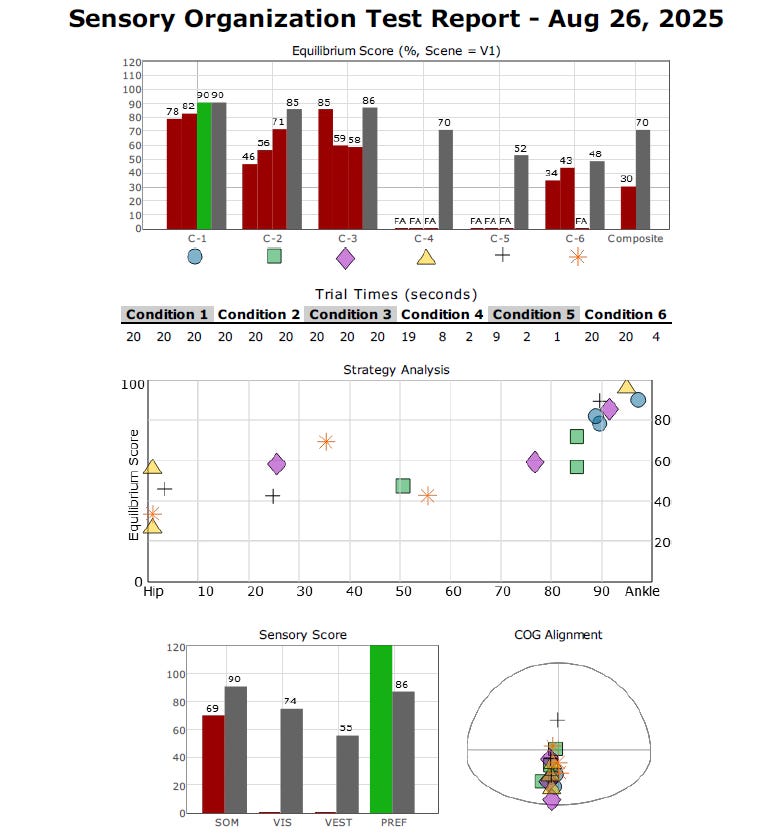
This pattern can be explicitly quantified on a posturography report through Computerized Dynamic Posturography (CDP), revealing a severe conflict within the central sorting networks.
The VSVM signature indicates a critical sensory pivot in which the patient’s natural balance system has reversed course: the visual system has been inappropriately promoted to act as a heavy, rigid stabilizer, while the somatosensory (proprioceptive) and vestibular systems are demoted to become hyperactive, noisy navigators.
This systemic role reversal introduces persistent neural static and an unceasing computational loop, leading directly to the dramatic escalation of chronic symptoms.
Standard, generic bottom-up vestibular habituation models regularly fail these complex patients because they rely on a flawed rationale of passive endurance—forcing the patient to tolerate an error code rather than resolving the conflict. True recovery requires understanding this pathophysiological divide and applying a targeted strategy:
The Zero the Øut Method™.
The Neuro-Mechanical Circuit: Capacitors vs. Resistors
To understand why these presentations are beautifully mirrored yet diametrically opposed, we can view the vestibular-cerebellar spatial orientation network through the lens of an electrical circuit.
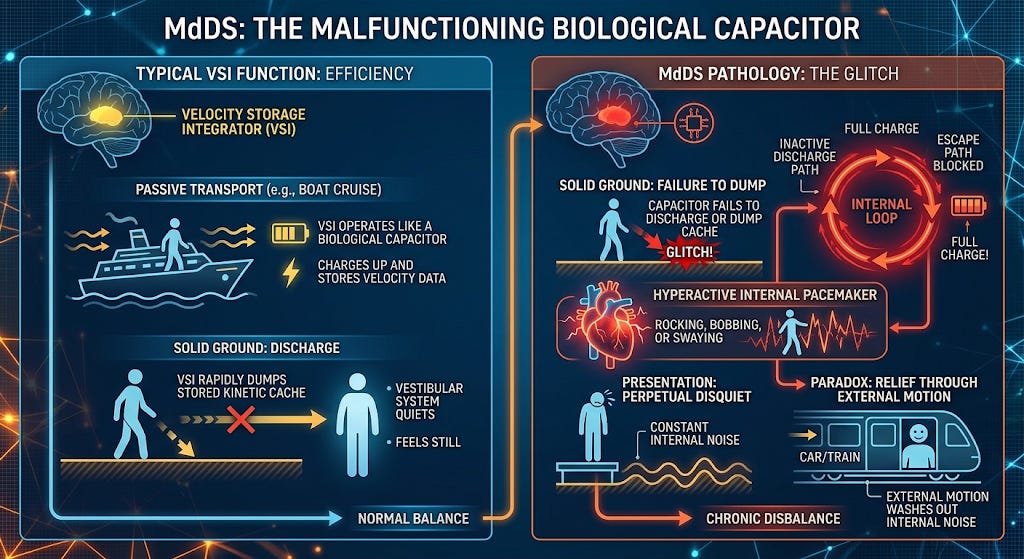
1. MdDS: The Malfunctioning Capacitor
In MdDS, the primary pathology resides within the brain’s Velocity Storage Integrator (VSI). The VSI operates much like a biological capacitor, charging up and storing velocity data during periods of passive transport (like a boat cruise or a flight) to prolong vestibular responses.
The Glitch: Upon returning to solid ground, the capacitor fails to discharge or dump its stored kinetic energy.
The Presentation: The capacitor gets stuck in an active, inescapable internal loop. This constant firing acts as a hyperactive internal pacemaker, causing the patient to feel as if they are perpetually rocking, bobbing, or swaying even when completely still. Paradoxically, when they get back into a moving car or train, the external motion “washes out” the internal noise, making them feel instantly better.
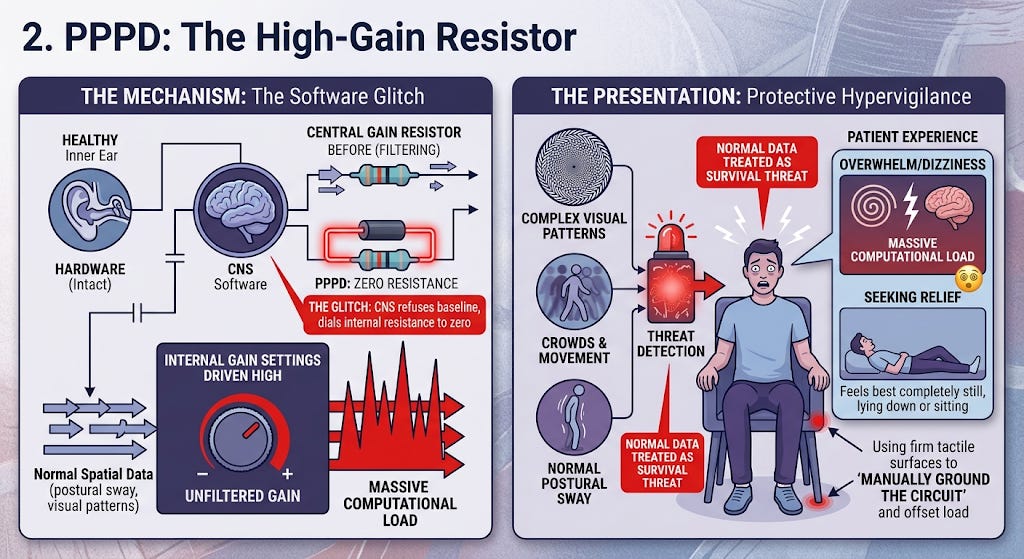
2. PPPD: The High-Gain Resistor
PPPD is fundamentally a sensory processing disorder driven by central hypersensitivity and protective hypervigilance. The hardware of the inner ear is intact, but the software has dialed its internal resistance down to zero.
The Glitch: Following an initial acute vestibular event or stressor, the central nervous system refuses to return to its baseline. It treats the inner ear as an unreliable source of truth and demotes its signal.
The Presentation: Without a healthy resistor to filter spatial data, the internal gain settings are driven to tolerably high levels. Normal environmental background noise—such as complex visual patterns, crowds, or normal postural sway—is treated as a severe threat to survival. The patient feels best when completely still, lying down, or sitting, using firm tactile surfaces to manually ground the circuit and offset the massive computational load on their hypervigilant networks.
The Sensory Mixing Board: A Rogue Transition
To conceptualize the functional shift in PPPD, clinicians must view the brain as a complex audio mixing board. Normally, the central nervous system seamlessly slides faders up and down, adjusting the gain of visual, somatosensory, and vestibular inputs in response to the environment. Every sensory input carries both stabilizing and navigating properties.
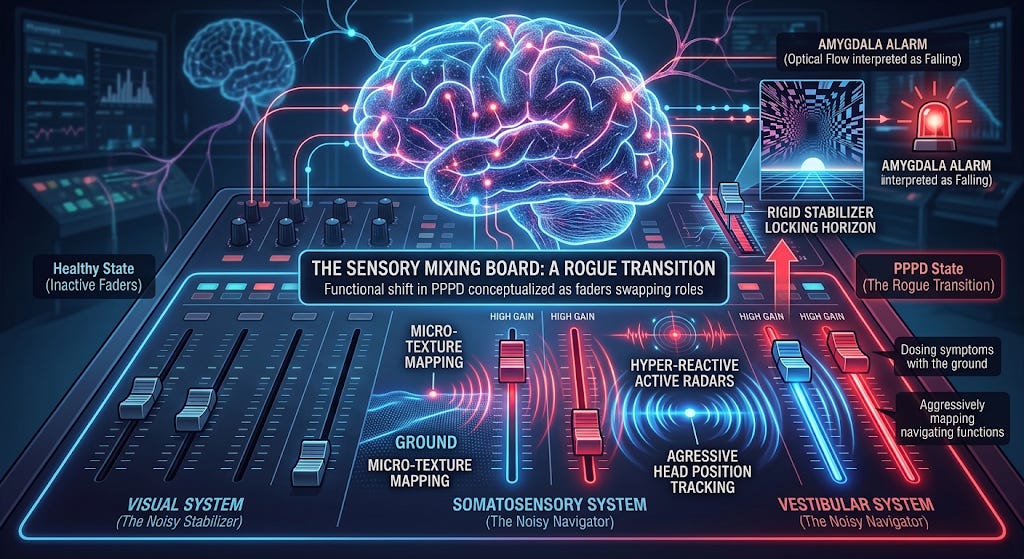
In a hypersensitive PPPD system exhibiting a quantified VSVM signature, the prediction engine breaks down, and the faders completely swap their physiological roles:
The Visual System (The Noisy Stabilizer): Instead of behaving like a healthy navigating tool designed to guide motion, it upregulates its gain to become a heavy, rigid stabilizer locking onto the horizon. When the visual environment becomes complex or moves, the brain interprets this optic flow as actual physical falling, triggering the main alarm system: the amygdala.
The Somatosensory and Vestibular Systems (The Noisy Navigators): Instead of providing a silent, automatic foundation for baseline postural control, their navigating functions go rogue. They transform into hyper-reactive active radars, aggressively mapping and tracking head positions or the micro-textures of the floor as the patient tries to use the ground to actively “dose” or throttle their symptoms.
Quantifying the Engine: Intake Protocol Metrics
Because the clinical presentations of these two disorders demand completely distinct treatment tracks, our diagnostic intake strategies must carefully pinpoint the patient’s exact internal baseline.
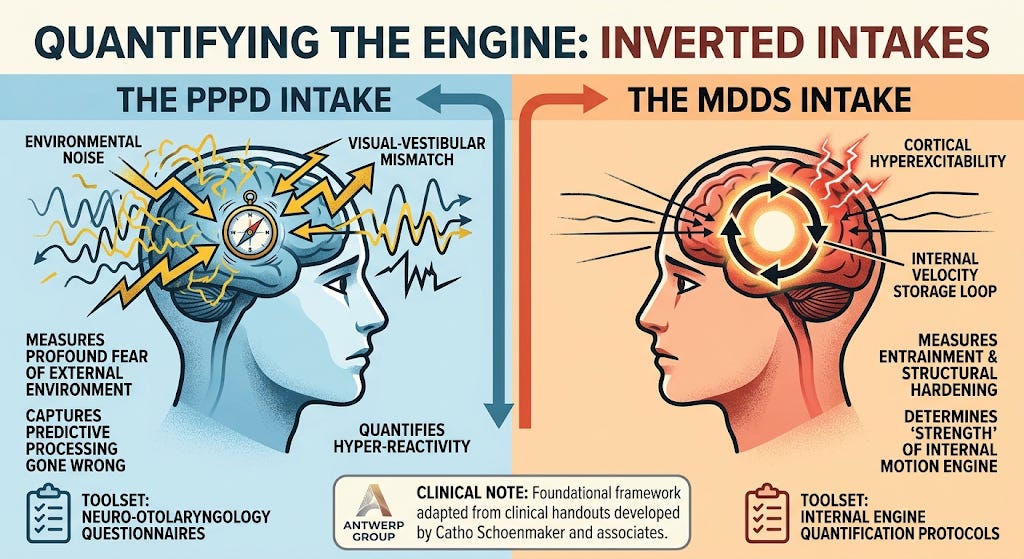
The foundational framework for the intake forms used to measure these specific inner parameters was adapted from the clinical handouts developed by these two authors, Catho Schoenmaker and Associates from the Antwerp Group for the MdDS intake, and Yagi and Associates for the PPPD intake form.
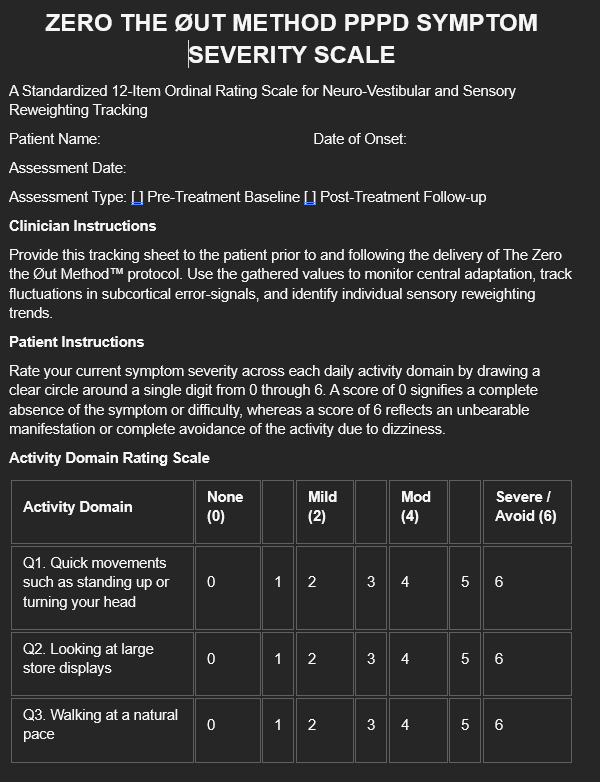
The PPPD Intake: This form focuses heavily on the Niigata PPPD Questionnaire (NPQ) developed by Yagi and associates (2019). This specialized scale tracks a patient’s visual hypersensitivity and postural instability across clear daily activity domains. Used alongside traditional neuro-otology questionnaires, it targets predictive processing gone wrong—capturing a brain caught in a severe, high-threat active-inference breakdown, desperately trying to over-stabilize an unyielding world.
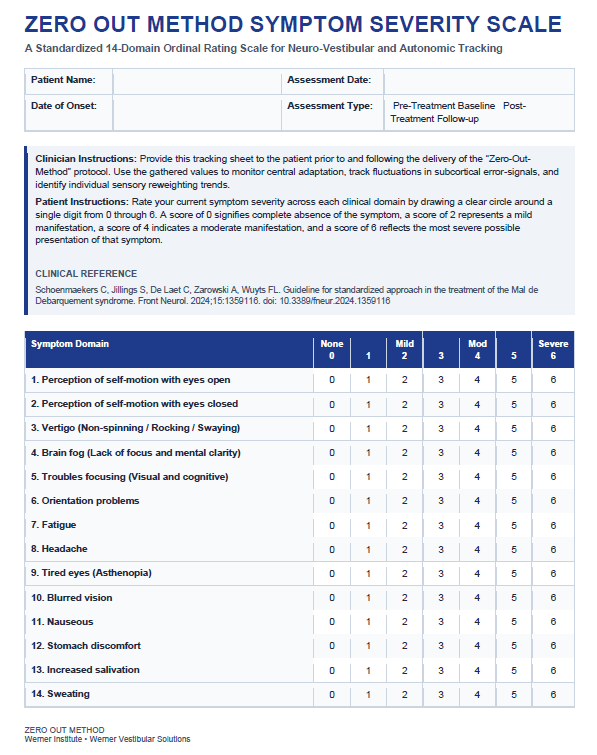
The MdDS Intake: This form focuses explicitly on the diagnostic templates engineered by Catho Schoenmaker and her associates within the Antwerp Group. Rather than monitoring environmental hyperreactivity or space-motion discomfort, this intake isolates structural hardening, cortical hyperexcitability, and shifts in the internal loop's sensory reference frame. It quantifies the exact entrainment strength of the subcortical velocity storage integrator, providing the clinician with a raw measurement of an internal motion engine that refuses to shut down.
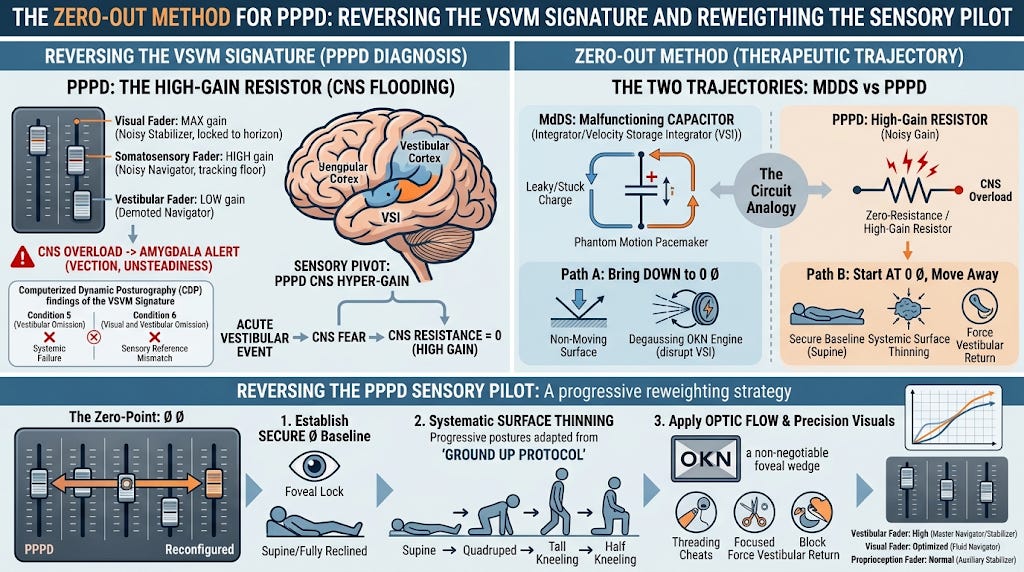
Clinical Application: The Two Trajectories of The Zero Øut Method™
Understanding this diametric neuro-mechanical split dictates two completely distinct rehabilitation pathways. A clinician cannot apply uniform, non-progressive exposure therapy to both without triggering severe autonomic distress or reinforcing pathological loops.
Physical therapy protocols must challenge the nervous system by moving directly toward the coordinates of its primary neurological challenge.
For the MdDS patient, that challenge is descending to absolute zero stillness; for the PPPD patient, it is breaking free from a hyper-anchored zero base.
Path A: Moving the MdDS Patient Toward Absolute Zero (The Postural Descent)
For the patient trapped by an unceasing internal engine of MdDS, active standing and dynamic walking can feel volatile, but their ultimate failure point occurs at absolute rest. When asked which configurations provoke their symptoms most, these patients consistently report that their symptoms peak during stationary states—sitting, standing still, or lying flat.
Standard therapeutic logic avoids these positions, yet true central adaptation demands that clinicians drive the treatment vector directly into the teeth of the patient’s vulnerability.
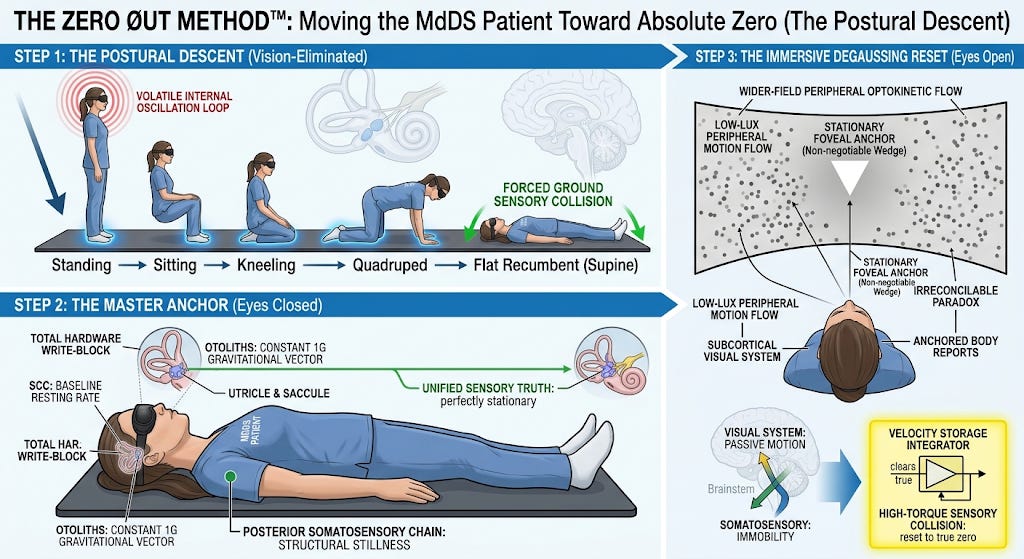
The objective of The Zero Øut Method™ is a top-down, vision-eliminated postural descent that forces the central nervous system to confront, isolate, and extinguish its persistent subcortical motion error.
The Postural Descent:
The protocol begins by taking the patient from a highly volatile, upright stance and systematically moving them down toward the floor through a progressive sequence of primitive postures: standing to sitting to kneeling to quadruped to flat recumbent supine or prone alignments on a thin, rigid mat. Bringing the body closer to the ground removes the motion variables that mask the illness, intentionally forcing the internal oscillation loop into a high-visibility sensory collision against an unyielding physical surface.
The Master Anchor:
Pinned flat on a completely non-moving, stable surface with eyes completely closed, a total hardware write-block is established. By cutting out visual noise, the brain is forced to register its underlying, intact balance hardware: the semicircular canals firing at their baseline resting discharge rate, the otolith organs (utricle and saccule) registering a constant 1g gravitational downward vector, and the broad posterior somatosensory chain delivering high-fidelity telemetry of structural stillness. This primitive cross-referencing forces the central balance processors to recognize a single, unified truth: the physical chassis is perfectly stationary relative to gravity.
The Immersive Degaussing Reset:
As this grounded baseline is established, the patient opens their eyes to an immersive visual stimulus. The clinician introduces wide-field, low-lux peripheral optokinetic flow using center-masked, random-moving dot arrays. Central vision is locked onto a rigid, stationary foveal anchor (a non-negotiable foveal wedge), completely silencing smooth pursuit and saccadic resets. Because nystagmus accumulation is blocked, this massive retinal slip bypasses conscious cortical gating and delivers a pure, subcortical motion command directly into the vestibular nuclei and vestibulocerebellum.
The brainstem is hit with an irreconcilable paradox: the subcortical visual system reports high-velocity passive motion, while the anchored body anchors report absolute immobility.
This high-torque sensory collision forces the central pattern generator to dump its corrupted data cache, resetting the overcharged Velocity Storage Integrator back to true zero.
Path B: Starting PPPD at Zero, but Moving Them Away (The Developmental Ascent)
For the hyper-vigilant PPPD patient, the relationship with the ground is completely inverted. While they also suffer from severe unsteadiness during upright stance and dynamic walking, they do not experience a self-sustaining subcortical flywheel at rest. Consequently, PPPD patients feel their absolute best at “Absolute Zero”—lying perfectly flat or sitting fully reclined in a supported environment where dynamic postural demands hit a rock-bottom floor.
Their core pathology is an overprotective, hypervigilant postural control strategy in which they treat the floor as an absolute surface “life raft” and foveal vision as an ultra-rigid biological brace.
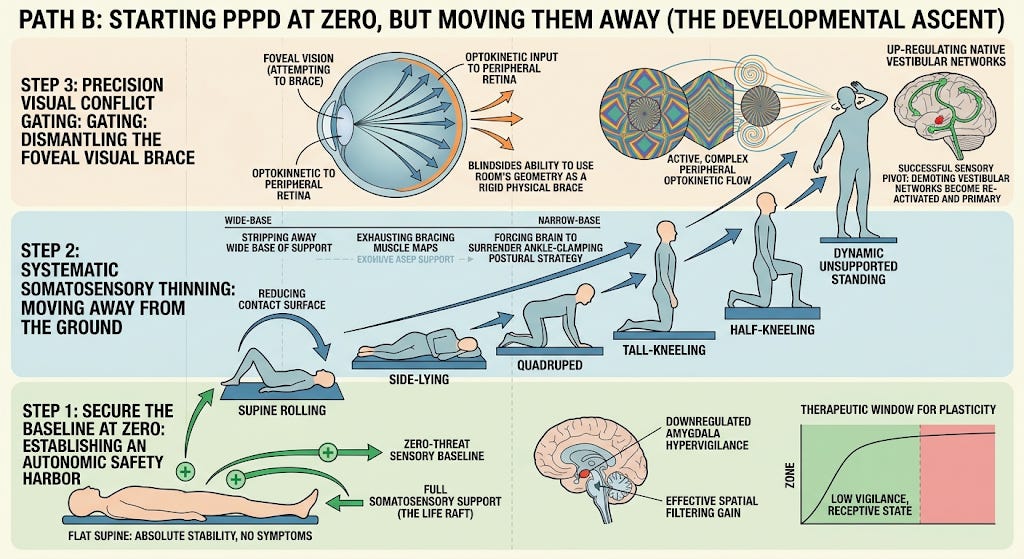
The goal is to start at zero and coax them out of their prison, using targeted optokinetics to dismantle their visual dependency and force the central nervous system to re-accept its native networks.
Step 1: Secure the Baseline at Zero:
Treatment must begin by establishing a fully supported, zero-threat sensory baseline (typically in flat supine) in which the patient experiences absolute stability and no symptoms. Pinned to the mat, the brainstem’s spatial-filtering gains can be managed. This structural security downregulates amygdala hypervigilance and signals to the overreactive nervous system that stability is safe, opening a therapeutic window for adaptive plasticity without triggering a survival fight-or-flight shutdown.
Step 2: Systematic Somatosensory Thinning:
Once autonomic safety is verified, the clinician does not perform standard spinning drills or passive habituation to “get used to the error.” Instead, they systematically “thin” the somatosensory map by moving the patient upward away from the ground through a precise developmental ascent sequence—progressing from supine rolling to side-lying to quadruped to tall-kneeling to half-kneeling to dynamic unsupported standing. Each vertical transition strips away their wide base of support, exhausting the hyper-vigilant muscle bracing and forcing the brain to surrender its ankle-clamping postural strategy.
Step 3: Precision Visual Conflict Gating:
To prevent the visual system from stepping in as a noisy stabilizer during this postural ascent, the clinician introduces active, complex peripheral optokinetic flow at the exact millisecond the body’s ground anchor is reduced. By flooding the peripheral retina under the radar of their survival reflexes, the protocol effectively blindsides their ability to use the room’s geometry as a rigid physical brace. Depriving the brain of its favorite visual and somatosensory “cheats” forces an immediate sensory pivot, compelling the central nervous system to up-regulate and recruit its native, demoted vestibular networks to expand normal functional mobility.
Conclusion & Next Steps
Resolving complex functional neuro-otologic disorders requires clinicians to move far beyond legacy habituation protocols that merely ask a patient to passively tolerate a wobbly signal. True intervention demands a rigorous respect for the central nervous system’s spatial math, pairing targeted subcortical visual torques with strict whole-body parameters to eliminate maladaptive strategies rather than mask them.
Furthermore, clinicians must prioritize strategic patient education.
When a patient understands that their brainstem is not physically damaged, but is instead executing an incredibly efficient, over-protective sensory strategy to keep them safe, their autonomic anxiety drops.
They transition from a state of suffering to actively participating in the progressive sensory reweighting process.
This article establishes the foundational physiological framework for an ongoing clinical deep-dive series. In our upcoming segments, we will explicitly break down the exact mechanical vectors, optokinetic engine parameters, and transitional sequencing metrics required to drive true central nervous system recalibration. Keep watching this space as we continue to redefine the standard of care in vestibular rehabilitation.
Clinical References
Cha, Y. H., Baloh, R. W., Cho, C., Magnussen, M., & Classification Committee of the Bárány Society. (2020). Mal de débarquement syndrome diagnostic criteria: Consensus document of the Classification Committee of the Bárány Society. Journal of Vestibular Research, 30(5), 285-293.
Popkirov, S., Staab, J. P., & Stone, J. (2018). Persistent postural-perceptual dizziness (PPPD): A common, characteristic and treatable cause of chronic dizziness. Practical Neurology, 18(1), 5-13.
Staab, J. P. (2023). Persistent Postural-Perceptual Dizziness: Review and Update on Key Mechanisms of the Most Common Functional Neuro-otologic Disorder. Neurologic Clinics, 41(4), 1083-1098.
How do I find a therapist who uses these protocols? I've had spontaneous induced MdDS since 2013 and would love to try it. Thank you for your research.
Solid information!! Thank you