
Unlocking Stillness: A Deep Dive into Mal de Debarquement Syndrome (MdDS) and Our Path to Recovery


For patients living with the disorienting reality of persistent motion and for my fellow physical therapists seeking practical solutions, Mal de Debarquement Syndrome (MdDS) presents a unique and often profoundly challenging condition. If you or your patient experiences a relentless feeling of rocking, swaying, bobbing, or an unsettling sense of internal movement – a sensation that arises specifically when you are on solid ground and not moving – often while sitting, standing still, or lying down – this article aims to help you understand what causes these sensations and what we are doing to treat them. This discussion may sound somewhat clinical, but I intend to explain the underlying mechanisms of MdDS and the logic behind our approach.
MdDS: When Your Brain's 'Normal' Becomes Constant Motion
Let's begin by understanding MdDS at its core. You must recognize that MdDS is not a typical Vestibulo-Ocular Reflex (VOR) disorder in the conventional sense, like BPPV or a peripheral hypofunction. Instead, MdDS involves a specific and often perplexing 'maladaptation of your brain's velocity storage center'.
Imagine your velocity storage center as the brain's internal gyroscope and motion calculator. It primarily processes and stores information about how your head and body are moving, ensuring your gaze stays stable and you maintain balance. Crucially, it also understands when you are 'not' moving.
In MdDS, a fascinating and distressing phenomenon occurs: You experience prolonged 'passive motion exposure' – perhaps during a long cruise, a turbulent flight, or an extended period in a vehicle. During this time, your brain undergoes an incredible act of adaptation, recalibrating its velocity storage center. It essentially 'entrains' or 'traps' itself, deciding that this constant motion is the new 'normal baseline'. So, when you disembark from the motion environment and external movement ceases, your internal system stubbornly believes it's still moving. The result? That relentless internal sensation of rocking, because your velocity storage center has now set 'motion' as its default state.

The Treatment Philosophy: Reverse Engineering with Optokinetic Nystagmus (OKN)
Our treatment strategy for MdDS builds on the concept of 'reverse engineering' the problem. The initial maladaptation stemmed from a passive, 'bottom-up' input (your body moving in a vehicle). We now aim to 'collide' with that existing, erroneous internal model by providing a precise, controlled 'top-down' sensory input: Optokinetic Nystagmus (OKN).
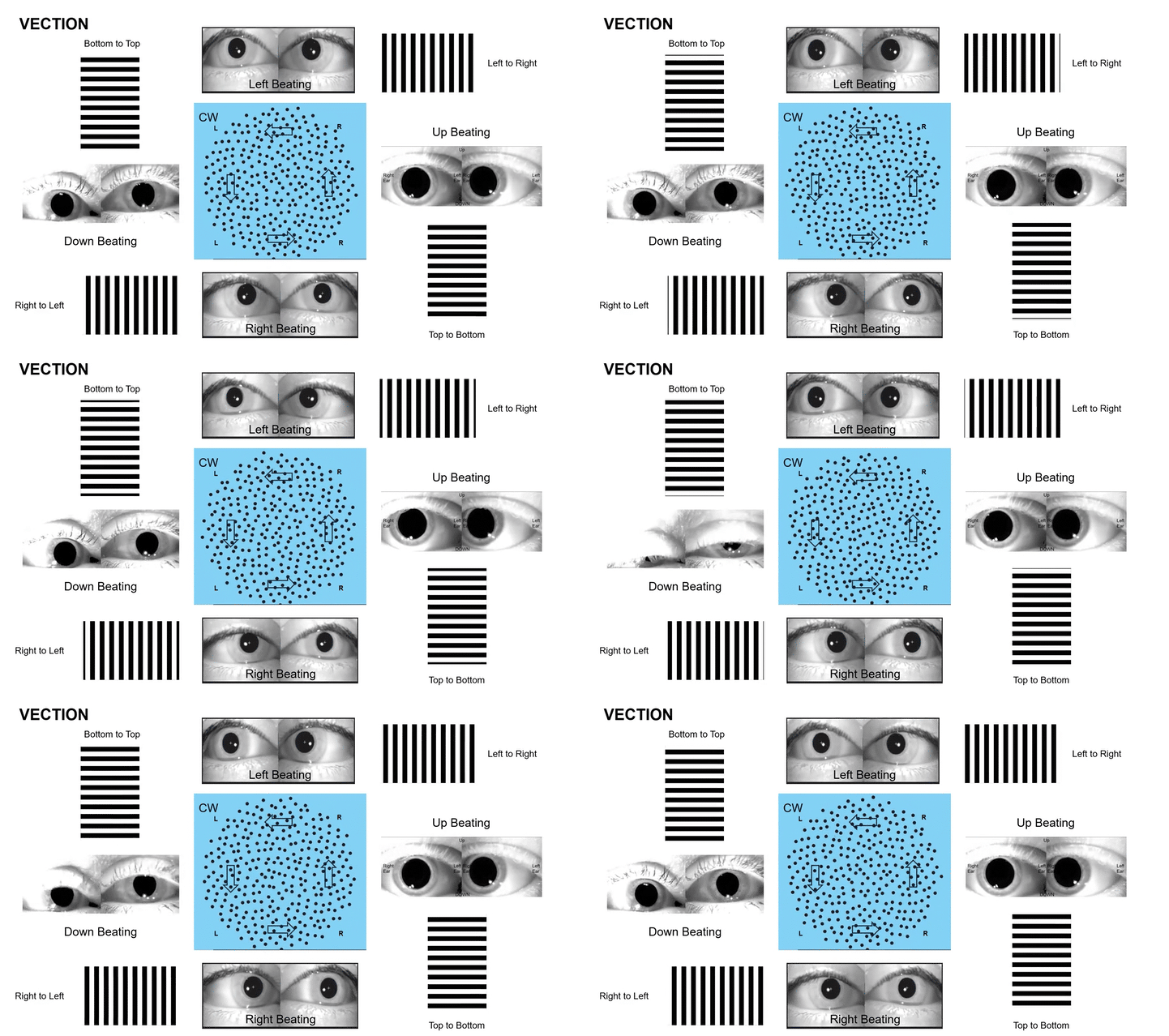
OKN describes the reflex eye movements that help stabilize your vision when you watch a moving visual field, like stripes on a rotating drum or scenery outside a train window. However, its power extends far beyond just eye movements. It is a potent tool for passively inducing a 'sensory torque' on your brain's motion-sensing systems.
Essentially, we intentionally create a powerful visual illusion of motion. This illusion, delivered passively to you, mimics the passive motion that initiated your MdDS, but with a critical difference: we control it, and we use it to force a new, corrective adaptation.
How We Access and Recalibrate Your System: The Nuance of Multi-System Engagement
While MdDS is not a direct VOR disorder, the VOR pathway serves as a vital conduit for accessing and recalibrating the velocity storage center. Here is how this 'top-down' torque induction works, engaging multiple systems to achieve recalibration:
Via the Eyes (VOR - Vestibulo-Ocular Reflex): The OKN directly stimulates your visual system, which then intricately links to your vestibular system through the VOR. This strong visual input acts as a powerful signal, directly challenging the erroneous 'motion-as-baseline' belief held within your velocity storage center. We use the VOR as the primary gateway to deliver this corrective visual 'motion' input. This primarily involves the 'translational' or 'linear VOR,' which detects linear movements rather than just rotations. We are stimulating this specific pathway with the visual illusion of linear motion.
Part of this precise recalibration also often involves a slow head tilt, typically performed at a frequency of 0.167 Hz. This frequency is believed to resonate with the velocity storage center itself. To put that in more understandable terms, 0.167 Hz translates to approximately 10 cycles per minute. This specific, low-frequency head movement, combined with the OKN stimulus, helps fine-tune the velocity storage system.
Via the Neck (VCR - Vestibulo-Cervical Reflex): Even while you consciously try to remain still, the compelling visual motion generated by OKN can induce subtle, unconscious activity in your neck muscles. This engagement of the VCR helps us influence how your brain processes head-on-body stability in the context of this powerful perceived motion. The VCR contributes to maintaining head posture in space and relative to the trunk. When the OKN creates a sense of self-motion, your VCR responds as if your body truly moves, forcing a new dialogue with your velocity storage center.
Via the Body (VSR - Vestibulo-Spinal Reflex): Similarly, the perceived motion from OKN can trigger very subtle, often imperceptible, postural adjustments and changes in muscle tone throughout your body via the VSR. This means the sensory 'torque' is not confined to your eyes and neck; it influences your entire postural control system, providing a holistic recalibration signal. Your body's muscles react to the perceived motion, creating a discrepancy between the visual input and actual physical movement, which the velocity storage center must resolve.
A crucial instruction for patients (and a key component for therapists): We ask patients to remain as still as possible during this process. The goal is to create a profound sensory conflict: your visual system and associated reflexes powerfully perceive motion, but your somatosensory and proprioceptive systems (from your body remaining still) send conflicting signals of 'no movement'. This deliberate clash forces your velocity storage center to confront its current, inaccurate calibration.

The March Test: A Glimpse into the Internal State
When we perform clinical assessments like the March test (marching in place with eyes closed), any observed deviation – marching to the right, left, forward, or backward – serves as a gross 'motor output' of what your velocity storage center 'currently believes is normal'. It is a visible manifestation of its maladapted baseline, helping us objectively track changes.
However, for patients, it is vital to remember that this external motor output might be entirely different from your 'internal perceived motion'. You might be marching to the left, but internally feel like you are swaying forward. As therapists, we are acutely aware of this distinction. Our treatment plans must address both the observable motor outputs and your subjective internal sensations, sometimes even by introducing exercises in different directions based on your tolerance and response.

Tailoring Treatment: Replicating Onset Conditions
To effectively reverse engineer the maladaptation, we often consider the context of your MdDS onset. Were you primarily lying down on a boat, or sitting, or standing? To maximize the effectiveness of the OKN stimulus, we may need to introduce these optokinetic exposures in various positions, while you are lying down, sitting, or standing still. This helps retrain the velocity storage center under the specific conditions that contributed to its initial, erroneous recalibration.
Vestibular Therapy: Solidifying the New 'Normal'
Once we successfully de-entrain the maladaptive pattern and re-entrain a normal one – where 'when I am sitting, I am not moving' – traditional vestibular therapy plays a vital role in reinforcing and maintaining that new, correct calibration.
Think of it like orthopedic rehabilitation: first, you regain range of motion and initial strength in an injured joint. Then, you integrate that new capability into functional movements and strength training to make it robust and lasting. The process for your balance system is very similar. We use OKN to 'reboot' the system and disrupt the old pattern, and then we integrate other vestibular exercises to solidify that newfound stillness and functional stability.
Our collective goal, for both patient and therapist, is clear: we guide your brain back to its natural state, where stillness truly feels like stillness, and the sensation of motion only occurs when you genuinely move. Please understand that this re-education process takes consistent effort and patience, as your brain works to establish a new, accurate baseline.
For patients: If you experience MdDS symptoms, discuss this information with your healthcare provider. Seeking out a physical therapist specializing in vestibular and balance disorders can provide you with a comprehensive evaluation and a tailored treatment plan.
For therapists: This article offers a conceptual overview of our approach to MdDS. Delving into the specific nuances of assessment and protocol implementation can significantly enhance your clinical toolkit for these challenging cases. Consider pursuing advanced training in vestibular rehabilitation to expand your expertise in this specialized area further.
Brian K. Werner, PT, MPT, has been a physical therapist specializing in vestibular issues for over 25 years and is the National Director of Vestibular Education & Training at FYZICAL.