
Why Your ‘Strengthening’ Plan Might Be Failing Your Patient with Dizziness


I recently saw a 78-year-old patient who perfectly exposed the critical flaw in the generic balance plan. She came to the clinic complaining of severe instability and ‘massive fatigue.‘
Naturally, many clinicians would see the fatigue and immediately focus on ‘strengthen endurance and gait balance training.‘ But I knew we had to look deeper.
On her initial visit, I ran two tests that yielded paradoxical results:
30-Second Chair Stand: She completed this test 20 times, well above the average for her age. This showed her primary Musculoskeletal Balance Disorder (MSBD®) capacity was excellent. She was clearly not weak.
Sensory Organization Test: The results were catastrophic. This woman demonstrated 11 falls during the test, especially when the surface was unstable. She could not basically stand up without external cues. She presented with what we describe at FYZICAL as a VSVM Sensory Mismatch—this means she is overcompensating with Vision greater than Surface cues due to profound Vestibular Dysfunction.
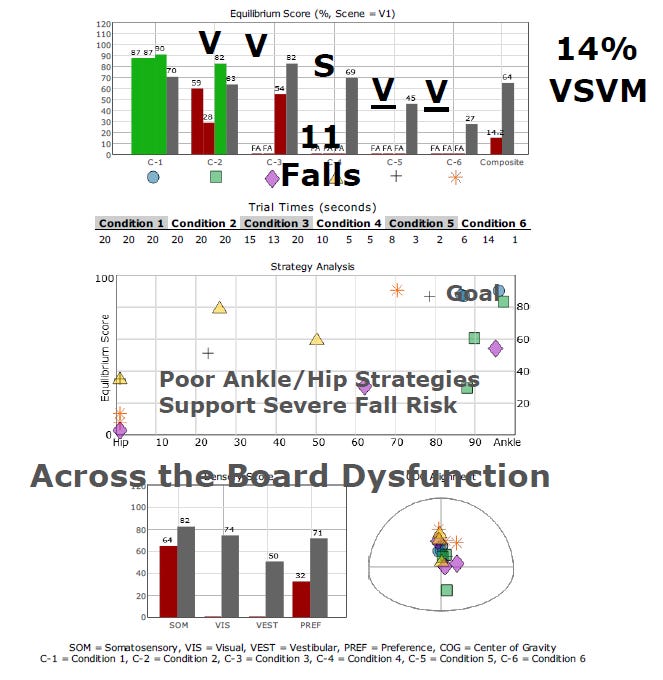
I scratched my head thinking, ‘Why is she so tired?‘ The answer was not in her muscles; it was in her nervous system. I realized her exhaustion was the direct result of her severe balance instability. She was forced into a state of continuous cognitive and physical overload.
The Source of the Exhaustion: Two Overloads
When a patient’s balance system fails this severely, the central nervous system panics and adopts two exhausting, compensatory strategies:
Cognitive Overload: Her cognitive system was constantly on fire. Balance should be a fast, automatic process, but for her, every step was a conscious, cortical decision. She was constantly on edge, worrying about falling. This high-alert state is not just nervousness; it is the most inefficient and energy-draining form of information processing. She was consciously processing her equilibrium all the time.
Physical Overload: Her body engaged in a widespread, rigid ‘bracing‘ pattern. She was overusing her entire musculoskeletal system when she was up and about, just to try to control her instability. Her muscles were held in a continuous, high-tension isometric contraction. This physical guarding is metabolically catastrophic and directly ‘leads to exhaustion.‘ The fatigue was not a cause of her balance problem; it was the epiphenomenon—the secondary symptom—of the sensory conflict.
The Proof: Treat the Conflict, Resolve the Fatigue
We treated her balance problem by targeting the specific sensory conflict. We did not focus on strengthening her already capable leg muscles.
After only one month of therapy, the results were undeniable.
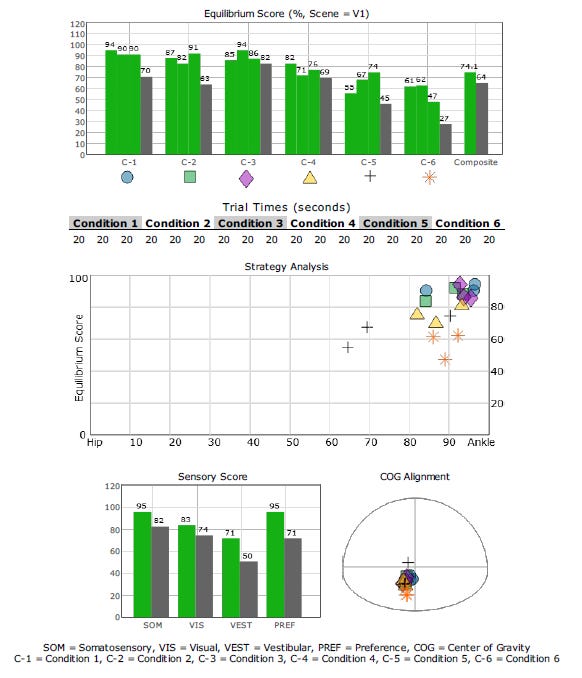
Look at her test results after only one month of therapy. Her balance system was working efficiently again. And the best part? She’s not tired anymore. Why? Because her balance system was no longer asking her muscles and her cortex to manage every single movement.
Her fatigue vanished, not because we made her stronger, but because we made her balance system more efficient. The brain’s mistrust faded, the bracing stopped, the conscious level receded, and the exhaustion disappeared.
This case proves the flaw in the generic plan. Before writing ‘strengthen endurance,’ clinicians must first be aware of this critical distinction. Are you treating an actual musculoskeletal deficit, or are you treating the exhausting ‘byproduct‘ of a sensory system in conflict? Understanding this can lead to more effective treatment strategies.
Brian Werner, PT, MPT, has been a physical therapist specializing in vestibular and balance disorders for over a quarter-century. He is the founder of the FYZICAL Balance Paradigm and one of the co-founders of FYZICAL, LLC, Balance Center Division with Dr. Daniel Deems, MD, PhD, where he serves as the National Director of Vestibular Education & Training.